
Bespoke bookcases in the UK, made to fit your space
A standard bookcase may be the better choice if its size and shelf layout already suit your room. But a bespoke bookcase in the UK makes sense when you need dimensions, shelving and finishes tailored to your space and what you plan to store. The intended use matters: books, display pieces and larger objects can call for different shelf depths.
It’s natural to want furniture that fits neatly without wasting space or compromising on appearance. A made-to-order design gives you more control, while a standard bookcase may be simpler when its proportions and features already meet your needs.
This guide explains practical reasons to choose bespoke, including how adjustable rows of holes let you reposition shelves. You’ll also learn what to consider when comparing materials, custom options and standard designs, so you can weigh up the choices carefully.
Table of Contents
Why Choose a Bespoke Bookcase?
A bespoke bookcase lets you tailor the dimensions, finish and shelving layout to your room. Start with what it needs to hold, then plan its position and purpose.
Display and storage layouts
Divide the layout by use: open shelving for books, a cupboard for items you’d rather keep out of sight, and glass-fronted sections for display. For example, keep frequently used books within easy reach and place keepsakes behind glass. Consider shelf depth in relation to the objects you’ll store, as oversized shelves can take up space without adding useful storage.
Adjustable shelves and hole spacing
Rows of holes allow shelf supports to move, so you can change shelf heights as your collection changes. In a 32 mm hole-spacing system, each position follows a regular vertical interval. That gives a repeatable adjustment pattern, rather than fixing every shelf permanently. Before choosing a layout, compare the spacing with the tallest books or objects you intend to store.
Made-to-measure bookcase price factors
The price of a made-to-measure bookcase depends on its dimensions, materials, finish and construction details. A layout combining open shelves, cupboards and glass-fronted sections requires different components from a simple run of shelves. Consider how intricate the design needs to be, and prioritise features that solve real storage or display needs.
Combining sections can make one piece work harder. A living-room design might have open shelves for books, lower cupboards for board games and a glass cabinet for treasured pieces. Decide which items should be visible and which need enclosed storage. Then place each section where it’s easiest to use, rather than letting decoration dictate the whole arrangement.
Material and finish shape a bookcase’s appearance and how it works with existing furniture. Oak, pine and MDF offer different starting points, while the finish further changes the overall effect. Compare samples with nearby flooring, tables or shelving, and consider whether a painted, stained or natural-looking surface best suits the room.
Built-in shelving can make use of alcoves, wall recesses and awkward corners that standard furniture may leave empty. Measure the available height, width and depth at several points, especially where walls or floors aren’t even. Record skirting boards, sockets and sloping ceilings too. These details help define a fitted layout and keep the bookcase from obstructing everyday access.
Before settling on a design, list the books, display objects and stored items it needs to accommodate. Group them by size and purpose, then use those examples to plan shelf heights, cupboard positions and glass sections. Precise measurements of the room and the items help turn a pleasing concept into practical shelving that fits its intended space.
What is the advantage of rows of holes for my custom bookcase system?
Rows of holes let you reposition shelves instead of fixing each shelf permanently. That flexibility helps a bookcase accommodate changing collections, from tall art books to shorter paperbacks. In a made-to-measure design, adjustable shelving can also make effective use of available height, particularly in alcoves and awkward spaces.
A 32 mm hole-spacing system places shelf-support positions at regular intervals. Move the supports to another matching pair of holes, then rest the shelf at its new height. The set spacing makes adjustments predictable, although positions remain limited to the holes provided. Plan around your tallest books and display objects before deciding where to place the supports.
Made-to-measure dimensions can account for a recess, an uneven wall or a narrow section beside a chimney breast. An alcove bookcase, for example, can use the width between the walls rather than leave a gap beside standard furniture. Tailored depth can also preserve access through a room, while a considered shelf layout provides storage without projecting unnecessarily into the space.
Measure each alcove carefully before finalising the design. Walls can vary in width from floor level to the top, and corners may not be square. Measure across the front at the bottom, middle and top, then repeat at the back if accessible. Record the smallest width and height, and note any skirting boards, sockets, pipes or sloping ceilings that could affect the fit.
Measure the full height, width and depth of the intended space.
Record width at several points, including near the floor and ceiling.
Note obstructions such as a skirting board or projecting pipe.
List the largest books or objects the shelves must hold.
Use those measurements to plan the bookcase’s outside dimensions and internal layout. For instance, a chimney-breast alcove may need narrower shelves near the front if the recess tapers. Check the room’s access route too: a bookcase designed to fit a wall still needs to be brought into position. Careful measuring clarifies the intended fit before materials are cut.
Adjustable holes and made-to-measure sizing solve different problems. The dimensions help the bookcase fit the room; the holes let you alter shelf heights within that structure. Together, they offer a practical solution when a fixed arrangement would waste space or fail to meet changing storage needs. Sketch the wall, mark obstructions and map shelf positions before finalising the layout.
Oak, pine and MDF material options
Oak, pine and MDF give a bookcase different looks, surfaces and practical considerations. Compare the grain, finish and intended use before choosing. A material that suits a painted bedroom design may have a different character from visible timber in a living room. Consider how the bookcase will sit alongside existing furniture, such as a dining table, floorboards or painted cabinetry.
Oak is a hardwood with a distinctive grain, making it a natural choice when you want the material itself to shape the room’s character. A clear or lightly coloured finish can keep the grain visible, while a darker stain changes its tone. If the bookcase will sit beside oak flooring, compare samples in the room’s natural light. The same wood can look different beside warm and cool colours.
Pine is a softwood with visible knots and grain. These markings give each board a distinct appearance, which can suit relaxed interiors and farmhouse-inspired furniture. Pine can be painted or stained, so decide whether you want its natural pattern to remain prominent. A painted bookcase, for example, can echo the skirting boards, while a clear finish keeps the timber’s character visible.
MDF is an engineered board made from wood fibres and resin. Its smooth surface provides a consistent base for paint, helping create an even-coloured finish across panels and shelves. Consider MDF when a clean painted appearance matters more than visible wood grain. Plan the finish alongside the bookcase’s purpose so appearance and functionality work together.
Compare each material against the details of the design, not just a small sample. A bookcase with broad side panels, cupboard doors and open shelves shows more surface than a narrow run of shelving. Consider how grain direction, knots or painted areas will appear across those parts. View a finish sample beside your room’s flooring and furniture, then assess it in daylight and lamplight.
For visible grain: compare oak and pine samples with nearby timber furniture.
For a painted look: consider MDF’s smooth surface and choose a colour that works with the room.
For a natural finish: decide whether oak’s grain or pine’s knots better suit the intended style.
Also consider how the bookcase will be used. A display-led design might put the finish and grain on show, while a study bookcase may prioritise a simple, cohesive surface across the shelves. For a mixed layout, compare the material on both open sections and doors. The same finish can look different across a large panel and a small shelf edge.
Make the decision in stages: identify the room’s existing colours, choose between visible timber and painted surfaces, then compare samples with the intended layout. Finally, consider the finish across the complete piece, including shelves, cupboard fronts and side panels. This helps the material support both the bookcase’s appearance and its everyday functionality.
Bespoke versus standard bookcases
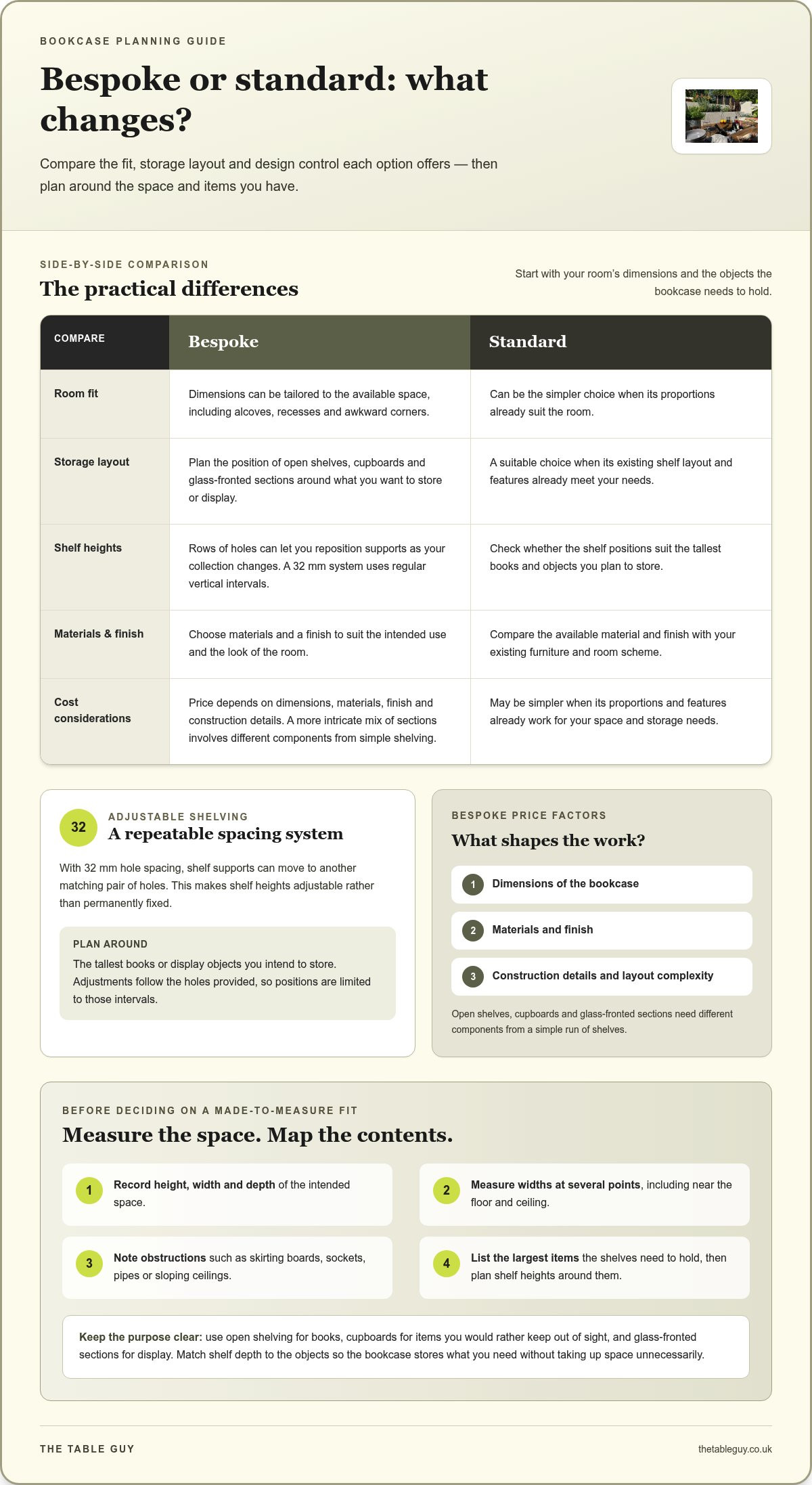
A standard bookcase suits a room when its proportions, shelving and finish already work for you. A bespoke design is useful when fixed options leave wasted space or don’t suit what you need to store. The choice is practical, not simply a question of which looks more considered. Start by comparing the available dimensions and layout with your room and belongings.
Market listings include Georgian bookcases measuring 1040 mm high, 1255 mm wide and 375 mm deep, alongside a taller version measuring 1900 mm high, 1255 mm wide and 375 mm deep. These examples show how set designs offer defined proportions. If a standard model fits your wall and holds your books comfortably, custom dimensions may add little value.
A bespoke bookcase in the UK can be tailored to your dimensions, shelving layout and chosen finish. This can matter in a room with an alcove, an unusually low ceiling or a wall interrupted by a chimney breast. Rather than choosing a model first, measure the usable space, note obstructions, then decide what the bookcase needs to hold. Let its intended use guide the shelf depth.
Compare the two choices against these practical points:
Room fit: check a standard bookcase’s height, width and depth against the intended wall.
Storage: compare its shelf spacing and depth with your largest books or display objects.
Interior: consider whether the available finish works with nearby flooring and furniture.
Adaptability: decide whether fixed dimensions and a set layout suit your likely needs.
In a living room, a standard bookcase may be enough for paperbacks and a few ornaments. A bespoke bookcase in the UK may make more sense if you need low cupboards beneath display shelves or a fitted piece around an awkward corner. The difference is how closely the design matches the room’s use, not a blanket claim that one option is better.
Check standard dimensions carefully before deciding. A Georgian Low & Wide bookcase measures 1040 mm high, 1255 mm wide and 375 mm deep; a Georgian Low & Narrow model measures 1040 mm high, 845 mm wide and 375 mm deep. Even related designs can differ in width, so compare the exact model with your measurements rather than relying on labels such as “wide” or “narrow”.
Choose standard when its dimensions, shelf arrangement and appearance meet your needs without awkward gaps. Choose bespoke when the room’s shape, storage plan or interior finish calls for a more tailored fit. Write down the wall measurements and the largest items to store, then use that list to make a clear comparison.
What factors affect the price of a made-to-measure bookcase?
The price reflects the materials, dimensions and work involved in the finished design. A narrow run of open shelving requires different components from a full-wall bookcase with cupboards. Start by defining the storage needs, then identify the features that make the piece fit your room. This helps separate essentials from details that add complexity.
Overall size: Height, width and depth determine how much material the design uses. A bookcase that fills a wall needs more components than a compact alcove unit. Measure the intended space and note any sloping ceiling, chimney breast or projecting pipe. These details affect the shape and construction needed for a close fit.
Material and finish: Oak, pine and MDF have different appearances and finishing requirements. The choice affects the design’s character and the work needed to achieve its chosen surface. A painted MDF design, for example, has a different finish from visible-grain oak. Consider the material alongside the room’s existing furniture and the look you want.
Internal layout: Open shelves, cupboard doors and glass-fronted sections each add components and decisions. A simple bookcase has fewer elements than one combining display storage with enclosed compartments. Decide which belongings need to be visible and which are better kept behind doors. Then prioritise those features in the layout.
Adjustability and detailing: Adjustable shelves require support positions within the sides, while fixed shelves use a set arrangement. Additional choices, such as shaped edges or contrasting finishes, also affect the work involved. Choose details for a clear purpose. Adjustable shelves, for instance, can accommodate books of varying heights, while a fixed shelf may suit a specific display arrangement.
Fitting and access: A bookcase designed for an alcove must account for the room’s measurements and obstacles. Consider how the finished piece will reach its intended position, especially where a stair turn or narrow doorway limits access. A built-in design also involves fitting details around walls, skirting boards and uneven surfaces. Include these practical requirements in the initial plan.
To compare designs fairly, write down the same core brief for each: room measurements, material, finish, shelf arrangement and any cupboards or glass sections. List optional features separately. This makes it easier to see which choices are essential and which could be simplified without losing useful storage or the intended appearance.
There isn’t one price that suits every layout. The dimensions, material, finish, storage features and fitting requirements all shape the work. If you’re also considering complementary furniture, explore shelving options as part of planning a coordinated room.
The Table Guy: Prosecco Dining Tables
The Table Guy is a natural next step if you’re furnishing a room beyond its bookcase. Its made-to-order range includes Prosecco Dining Tables, Farmhouse Tables, Bamboo & Hardwood Tables, and Scaffold Board & Pine Tables. These options can help you consider the room as a whole, balancing a bookcase with a dining table that suits your interior and everyday use.
Choose a table style by considering the materials and character already present in your space. A farmhouse design may complement a relaxed interior, while bamboo or hardwood brings natural timber into the room. For a distinctive dining area, explore Prosecco Dining Tables.
To discuss your furniture plans, visit The Table Guy’s website.
Shape a room that works for you
Let the room’s everyday use guide your next design decision. A bespoke bookcase in the UK can be planned as part of a wider interior, so consider how its position, finish and storage will sit alongside the furniture you already own. A simple room sketch can help you plan reading, display and dining areas together.
If you’re furnishing more than one part of your home, The Table Guy offers Prosecco Dining Tables, Farmhouse Tables and Bamboo & Hardwood Tables. These can help create a cohesive feel around a carefully chosen bookcase, while giving the dining area its own character.
Take your room measurements and ideas into the next planning stage. Choose the features that matter most, then decide how each piece should support the way you live. For help with your wider furniture plans, contact The Table Guy. Make the space your own, one thoughtful choice at a time.
Frequently Asked Questions
What materials and finishes are available for custom bookcases?
Oak, pine and MDF are common material choices, with finishes selected to suit the room and intended look. Before deciding, compare samples beside nearby flooring and furniture, ideally in daylight and lamplight. This can reveal differences in colour and texture that are less obvious on a screen. For a painted finish, consider how its colour will relate to the walls and skirting boards.
How do bespoke bookcases compare with off-the-shelf shelving?
Bespoke shelving gives you more control over dimensions and internal arrangements, while off-the-shelf designs offer set proportions and layouts. The right choice depends on your room and what you need to store. For a straightforward wall and standard-sized books, a ready-made unit may be entirely practical. If your collection includes oversized art books or unusual objects, compare shelf dimensions and storage options before choosing.
How do I measure a room for a fitted bookcase?
Measure the intended area and record the dimensions alongside a simple wall sketch. Mark the floor finish, skirting boards, sockets, radiators and the direction nearby doors open. These details can affect where the bookcase sits and how you use it. Also measure the largest item you plan to store, such as an atlas or storage box, so its shelf space is considered in the design.
Can a bespoke bookcase be fitted around a fireplace, alcove or uneven wall?
A made-to-measure design can be planned around features such as a fireplace, alcove or uneven wall. Sketch the area and mark the mantel, hearth, chimney breast and any visible changes in wall depth. Note which features need to remain accessible, such as a socket or fireplace control. These details help shape the bookcase’s outline and usable storage, rather than treating the wall as a simple rectangle.
How long does it take to design and install a bespoke bookcase in the UK?
The process typically includes a consultation with a designer, measurement and crafting, followed by professional fitting.
What should I look for when choosing a bespoke bookcase maker?
Look for a maker who can tailor dimensions, shelving layouts and finishes to your space and intended use. Check that the process includes careful measurement and clarify whether professional fitting is offered, as custom bookcases may also be delivered flat-pack.

Comments