
Guide to Choosing a Pedestal Breakfast Table for Your Home
The traditional four-legged table is often the very thing standing between you and a peaceful morning routine. You've likely felt the frustration of squeezing into a tight kitchen nook only to knock your knees against a clunky wooden leg, or perhaps you're tired of the persistent, distracting wobble of a flimsy, mass-market base. It shouldn't be this difficult to enjoy a simple cup of tea. By choosing a bespoke pedestal breakfast table, you can finally transform that awkward corner into a functional, inviting hub that offers complete freedom of movement. This guide explores how British artisan quality and made-to-order design can maximise your floor plan whilst creating a durable centrepiece that lasts for decades. We'll walk through the essential considerations for stability, material choice, and sizing to help you find the perfect fit for your home. Let's build something beautiful together.
Table of Contents
Why Choose a Pedestal Breakfast Table for Your Kitchen Nook?
The Artisan’s Approach: Stability and Craftsmanship in Pedestal Design
Round, Square, or Oval? Selecting the Perfect Shape for Your Space
From Reclaimed Pine to Sustainable Bamboo: Selecting Your Ideal Timber
The Bespoke Difference: Creating Your Made-to-Order Breakfast Hub
Why Choose a Pedestal Breakfast Table for Your Kitchen Nook?
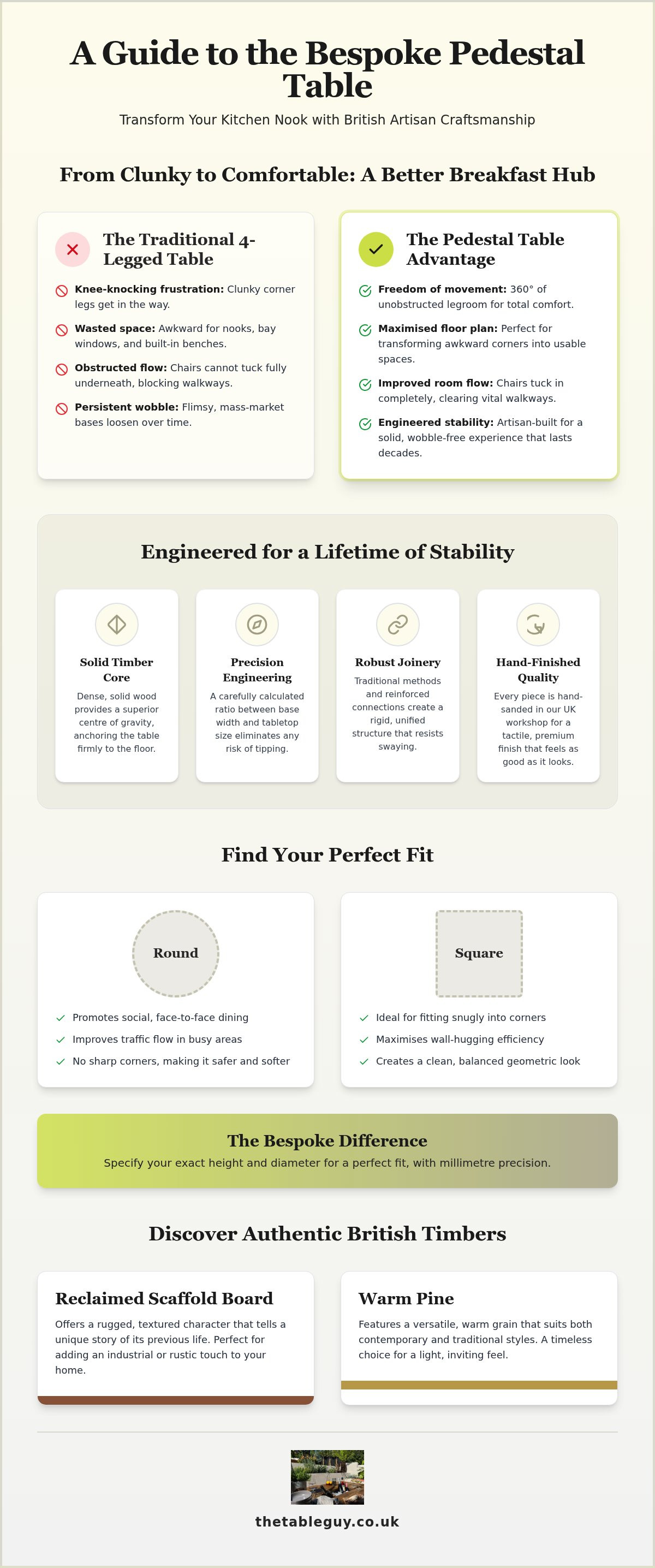
A pedestal breakfast table is defined by its singular, central support column. Unlike traditional designs that rely on four legs positioned at the corners, this architecture shifts the entire weight-bearing structure to the middle. It’s a simple change that completely redefines how you interact with your furniture. We often see customers who are tired of the daily "dance" required to sit at a standard table. You know the one: shuffling chairs, bumping knees, and apologising to guests as they try to get comfortable.
The most immediate benefit is what we call the legroom revolution. We’ve all experienced the frustration of a cramped kitchen where you’re constantly dodging table legs. With a central pedestal, those obstacles vanish. You gain 360 degrees of unobstructed space, allowing family to sit comfortably without knocking knees or straddling a wooden post. It makes every meal feel less like a spatial puzzle and more like a relaxed gathering. Beyond the practical, there is an undeniable aesthetic appeal. A central base acts as a visual anchor, drawing the eye to the centre of the room and creating a balanced, symmetrical focal point that feels both grounded and light. This design choice allows the beauty of the timber to take centre stage without being obscured by corner posts.
The Spatial Benefits of a Central Base
Maximising floor space is vital in busy British kitchens. Without corner legs, chairs tuck further under the tabletop when they aren't in use, clearing walkways and improving the flow of open-plan areas. You aren't restricted by the distance between legs, making it easy to pull up an extra stool. It turns a compact surface into a versatile morning hub that doesn't feel cluttered or overbearing.
Perfect for Breakfast Nooks and Bay Windows
Four-legged tables often clash with built-in benches, making it difficult to slide into your seat. A pedestal breakfast table solves this by providing a central anchor that stays out of your way. It creates a cosy, booth-like feel in bay windows or corners. By choosing a made-to-order piece, you ensure the base is weighted correctly for your specific architectural features, providing a solid foundation for your daily routine.
The Artisan’s Approach: Stability and Craftsmanship in Pedestal Design
The most common concern we hear from customers is the "wobble factor." It’s a valid worry. Many mass-produced versions found in high-street shops rely on lightweight, hollow materials and flimsy bolt-on components that inevitably loosen over time. Our approach in the workshop is entirely different. We treat every pedestal breakfast table as a structural masterpiece, prioritising the physics of weight distribution as much as the aesthetic finish. True stability comes from mass and precision, not just luck.
We use solid timber, which provides a naturally superior centre of gravity compared to composite alternatives. A piece of furniture is only as stable as its foundation. By using dense, high-quality wood like pine or hardwood, we ensure the base has the necessary heft to anchor the entire piece firmly to your floor. We don't just attach a top; we engineer the connection to handle the rigours of daily life.
Engineering a Wobble-Free Experience
Achieving absolute stability requires a precise ratio between the base width and the tabletop circumference. If the base is too narrow, the table becomes prone to tipping when pressure is applied to the edges. We calculate these dimensions carefully for every bespoke order to ensure safety. Our central columns are secured to substantial floor plates and reinforced top brackets using traditional joinery methods. This creates a rigid, unified structure that resists the swaying motions common in cheaper, flat-pack alternatives.
Hand-Finished Details in Our UK Workshop
There is a tactile quality to artisan work that machines simply cannot replicate. Every pedestal base is hand-sanded in our workshop to ensure a smooth, inviting finish that feels as good as it looks. You might prefer the rugged, textured character of a chunky scaffold board base that tells a story of its previous life. Alternatively, you could opt for a sleeker, contemporary column in warm pine. Because we are a family-run enterprise, we oversee every detail from the first cut to the final wax. We believe your pedestal breakfast table should be a durable centrepiece that stays steady through decades of family meals. If you are ready to move away from flat-pack frustrations, you can browse our full range of bespoke tables to find your perfect match.
Round, Square, or Oval? Selecting the Perfect Shape for Your Space
Choosing the right geometry for your kitchen is about more than just matching your existing decor. It’s about understanding how you and your family move through the room during the morning rush. A pedestal breakfast table acts as a functional anchor point, and its shape dictates the entire "flow" of the kitchen. While a standard four-legged table creates hard boundaries, the central base of a pedestal design allows the tabletop shape to truly shine without structural clutter.
Before you commit to a specific design, consider the architectural lines of your room. Are you trying to soften a modern kitchen filled with sharp angles, or are you looking to maximise every millimetre of a rectangular alcove? We always recommend using masking tape on your floor to "map out" the table's footprint. Leave at least 60cm to 90cm of "walk-around" space between the table edge and the nearest wall or cupboard. This ensures you can pull chairs out comfortably without blocking the path to the kettle or fridge.
Round Tables: The Social Favourite
The round pedestal breakfast table is our most requested design for a reason. By removing corners, you naturally encourage eye contact and easier conversation. It’s the perfect social hub for two to four people. In smaller British kitchens, the lack of sharp edges makes the room feel larger and prevents painful bumps in tight walkways. It’s an effortless way to bring a sense of softness and balance to a functional space.
Oval and Square: When You Need More Surface
If you have a larger family or frequently host brunch, an oval table provides the generous length of a rectangle whilst retaining the gentle, curved aesthetic of a circle. It’s a sophisticated middle ground. For those who prefer a contemporary, geometric look, square pedestal tables offer a bold statement. They are particularly useful in very tight nooks because they can be pushed flush against a wall when not in use. In open-plan homes, many of our customers choose to pair their dining setup with bespoke coffee tables that mirror the same timber and shape, creating a cohesive, artisan feel throughout the living area.
Round: Best for flow, conversation, and compact nooks.
Square: Ideal for modern aesthetics and wall-hugging efficiency.
Oval: Perfect for larger families who want a softer silhouette.
From Reclaimed Pine to Sustainable Bamboo: Selecting Your Ideal Timber
The timber you choose defines the soul of your furniture. It’s the most personal part of the journey, moving beyond simple measurements to the tactile reality of your daily life. A pedestal breakfast table should be more than a functional surface; it should be a piece of living history that complements the warmth of your home. Whether you prefer the rugged narrative of reclaimed wood or the refined elegance of polished hardwood, your choice of material dictates how the piece will age and interact with your kitchen’s light.
In our workshop, we see a growing shift toward materials that tell a story. Sustainable bamboo has become a favourite for the eco-conscious homeowner, offering a sleek, modern grain that is incredibly hard-wearing. For those seeking a more formal or traditional aesthetic, our hardwood options provide a dense, heavy foundation that feels substantial and permanent. Every plank is selected by hand, ensuring that the natural knots and unique grain patterns are celebrated rather than hidden.
The Rugged Charm of Scaffold Board and Pine
There is something deeply reassuring about the character of a scaffold board table. These reclaimed materials have already proven their durability on British building sites, and they bring that same resilience to your breakfast nook. They are perfect for high-traffic areas where life happens. A stray tea spill or a knock from a heavy mug doesn't ruin the surface; it simply adds to the rustic story. Pine remains a versatile classic, offering a softer, warmer timber that develops a beautiful patina as the years pass. If you are looking for more material inspiration, you might enjoy our guide to custom farmhouse dining tables, which explores these textures in even greater detail.
Finishing Touches: Waxes, Stains, and Colours
The finish is what bridges the gap between the workshop and your kitchen cabinetry. We use high-quality protective oils and waxes to ensure your pedestal breakfast table is ready for the realities of a busy morning. These finishes don't just enhance the colour; they create a barrier against spills and heat. Maintaining that "fresh from the workshop" look is simple with occasional re-waxing, allowing the timber to breathe whilst staying protected. You can choose a stain that matches your flooring or opt for a natural clear coat that lets the raw beauty of the wood shine through. If you are ready to start your project, you can view our handcrafted table options to see these finishes in action.
The Bespoke Difference: Creating Your Made-to-Order Breakfast Hub
Most mass-market retailers design for a generic floor plan that rarely matches the quirky reality of a British home. Whether you're dealing with a shallow alcove, a high-silled bay window, or an irregular corner, an off-the-shelf solution often leaves you with wasted space or a cramped walkway. Choosing a bespoke pedestal breakfast table allows you to reclaim those awkward spots. You aren't forced to settle for a standard 75cm height if your vision involves reclaimed timber paired with sleek bar stools; we can adjust the verticality to suit your specific seating needs perfectly.
Precision is at the heart of what we do in our UK workshop. We work to the centimetre, ensuring your table fits your nook with the kind of accuracy that mass production simply cannot offer. This isn't just about aesthetics; it's about the ergonomics of your daily life. A table that is even five centimetres too wide can be the difference between a clear path to the kettle and a constant, frustrating obstacle during the morning rush.
Sizing Your Table for Your Unique Nook
Calculating the ideal diameter starts with your diners. As a general rule, allow roughly 50cm to 60cm of table edge per person to avoid clashing elbows. However, in a compact breakfast hub, the central support of a pedestal design is your greatest ally. It allows you to maximise the surface area whilst keeping the floor footprint minimal. By working directly with our artisans, you can specify a diameter that accommodates your family comfortably without encroaching on vital kitchen traffic zones. We help you find that balance between a generous surface and a clear floor plan.
Investing in Longevity Over "Fast Furniture"
A handcrafted pedestal breakfast table is a genuine investment in your home's future. Because we use solid materials, your table can be sanded back and refinished in years to come, allowing it to evolve alongside your interior style. It becomes more than just a piece of furniture; it’s a durable, beautiful hub where your family’s stories are told every morning. We invite you to step away from the disposable and choose a centrepiece that carries the pride of British craftsmanship into the heart of your home. To complement such a lasting investment, you might also explore cookware from Oalamea.ro to find high-quality kitchenware that matches your artisanal aesthetic.
Your morning routine deserves a centrepiece that combines effortless flow with lasting durability. By choosing a pedestal breakfast table, you're opting for a design that prioritises your comfort, removing the obstacles of traditional legs whilst maximising every inch of your kitchen nook. From the technical stability of our weighted bases to the unique story told by our reclaimed timbers, a made-to-order piece ensures you never have to settle for "good enough" again.
We've been a family-run business since 2014, dedicated to the preservation of traditional skills in a modern world. Every item is hand-crafted in our UK workshop, where we specialise in bespoke sizing to ensure your new hub fits your home with millimetre precision. It’s time to move away from the fragility of mass-produced furniture and invest in a partnership with skilled artisans who care about the longevity of your home. You're not just buying a table; you're commissioning a piece of history.
Browse our range of bespoke handmade tables and start your project today. We look forward to bringing your vision to life and creating a hub your family will cherish for decades.
Frequently Asked Questions
Is a pedestal breakfast table as stable as a four-legged table?
A pedestal breakfast table is exceptionally stable when crafted from solid, heavy timber rather than hollow composites. In our workshop, we calculate the precise weight distribution needed to prevent tipping or wobbling. By using substantial floor plates and central columns, we ensure the table remains grounded even when pressure is applied to the edges. This artisan approach provides a solid foundation that rivals any traditional four-legged design.
How many people can comfortably sit at a 90cm round pedestal table?
A 90cm round table typically accommodates two to four people comfortably for a relaxed morning meal. Because there are no corner legs to navigate, diners have total freedom to arrange their seating without knocking their knees. It is the ideal size for a compact kitchen nook, providing a generous surface area whilst maintaining a small footprint that won't block the natural flow of your room.
Can I customise the height of my pedestal table for bar stools?
We can certainly customise the height of your table to match bar stools or standard chairs. Since every piece is made-to-order in our UK workshop, you aren't restricted by standard retail dimensions. Whether you need a taller "bistro" feel or a specific height to clear a low window sill, we adjust the central column to your exact requirements. This flexibility is a core part of our bespoke service.
What is the best wood for a kitchen breakfast table that gets heavy use?
Hardwood and scaffold board are the most resilient options for tables that face the rigours of daily family life. Hardwoods like oak provide a dense, scratch-resistant surface, whilst reclaimed scaffold boards offer a rugged durability that actually improves with age and character. Both materials are far superior to mass-produced veneers, as they can be sanded back and refinished if they ever sustain heavy wear.
How do I measure my kitchen nook to ensure the table will fit?
You should measure the floor area and subtract at least 60cm to 90cm from every side to allow for walk-around space. This ensures chairs can be pulled out without hitting walls or cupboards. We recommend using masking tape to mark the table's diameter on your floor. This simple trick helps you visualise the physical presence of the piece and ensures it won't impede the busy traffic zones of your kitchen.
Do you offer different base styles for your pedestal tables?
We provide a variety of base designs ranging from chunky, rustic timber columns to sleeker, contemporary metal supports. You can choose a style that reflects the architecture of your home, whether that's a traditional farmhouse feel or a modern industrial look. Because we specialise in bespoke creation, we can often adapt the base thickness and shape to complement your chosen tabletop material and the overall weight of the piece.
How do I maintain a handmade wooden table to prevent staining?
Regular application of high-quality protective oils or waxes is the best way to maintain the timber's natural barrier against spills. We finish every table with a durable coating before it leaves our workshop, but occasional re-waxing at home will keep the wood hydrated and stain-resistant. Wiping up spills immediately with a soft, damp cloth will ensure your handmade table retains its fresh from the workshop beauty for many years.
Why should I choose a bespoke table over a mass-produced one?
Choosing a bespoke pedestal breakfast table means investing in a piece that fits your home's unique dimensions perfectly whilst avoiding the environmental waste of fast furniture. Unlike mass-produced flat-pack items, our tables are built to last for decades and can be fully customised in height, diameter, and timber choice. You are supporting British craftsmanship and receiving a durable, beautiful centrepiece that is tailored specifically to your family's needs and lifestyle.


Comments