
Is Bespoke Furniture Worth It? The 2026 Guide to British Artisan Value
Updated: Aug 22
What if the most expensive piece of furniture you ever buy actually ends up costing you the least over your lifetime? It's a question many homeowners face when staring at a peeling veneer or an awkward gap in a living room that simply wasn't built for standard high-street dimensions. You're likely asking, is bespoke furniture worth it when mass-produced alternatives are so easily accessible? We've all felt the sting of settling for a "good enough" table that loses its charm and structural integrity before the toddler has even reached school age. It's a cycle of waste that lacks both character and common sense.
We believe the true value isn't found in the transaction, but in the decades of use that follow. In this 2026 guide, you'll discover the genuine ROI of British artisan pieces, from the unmatched durability of solid hardwood to the unique joy of a Prosecco table tailored to your social life. We'll walk you through the journey from our workshop to your home, showing how local craftsmanship solves modern space problems whilst creating the family heirlooms of tomorrow. Expect a clear look at how custom-made quality protects your investment and honours the heritage of traditional British making.
Table of Contents
Understanding the Bespoke Difference: Beyond the Price Tag
Bespoke furniture is more than just a luxury purchase. It's a collaborative journey between you and a maker. The origin of the term bespoke traces back to the tailoring world, where a piece of cloth was "be spoken for" by an individual client. In our workshop, this means your table or sideboard doesn't exist until you do. We don't build for an imaginary average consumer. We build for your specific dining room, your unique family habits, and your personal aesthetic. Whilst a mass-market retailer sees a transaction, a passionate artisan sees a partnership. This human-centric approach ensures that every joint is cut with intention and every surface is finished with care.
The sensory experience of commissioning a piece is something a flat-pack box can't replicate. You can't smell the rich, earthy scent of fresh timber through a computer screen, nor can you feel the subtle texture of hand-planed grain on a mass-produced veneer. Many homeowners wonder is bespoke furniture worth it when they see the initial cost. The answer often arrives the moment you touch a hand-finished surface. There's a weight, a warmth, and a soul to a piece that has been crafted by hand in a British workshop. It's the difference between a house filled with objects and a home filled with stories.
Bespoke vs. Custom: What Are You Actually Buying?
It's helpful to distinguish between "bespoke" and "custom" to understand your investment. Bespoke means a blank canvas. Every millimetre is tailored to your requirements. However, customising our existing designs, such as our farmhouse tables or sideboards, offers a brilliant middle ground. You might choose a specific timber like sustainable bamboo or characterful pine. You can decide on the exact length to fit a narrow British hallway or a specific alcove. This flexibility allows you to solve architectural puzzles that standard furniture simply ignores. You aren't just buying a product; you're buying a solution—an approach shared by expert cabinetmakers like Bois & Design who specialise in tailored interior layouts.
The UK is seeing a significant shift away from "fast furniture" in 2026. We've all seen the cycle of veneer peeling and cam-locks loosening after just three years of use. This throwaway culture is being replaced by a desire for "fewer, better things." People are tired of furniture that ends up in a landfill before the decade is out. Choosing a piece with a known origin story provides a psychological groundedness. You know who made it. You know where the timber came from. This transparency creates a lasting connection that mass-produced items can never offer.
The Economics of Quality: Why Custom Pieces Cost Less Over Time
This appreciation for heritage and lasting quality is a cornerstone of the vintage market too, where specialists like The Mid Century Design Co. help homeowners identify the authentic design features that have allowed mid-century pieces to remain stylish and functional for decades.
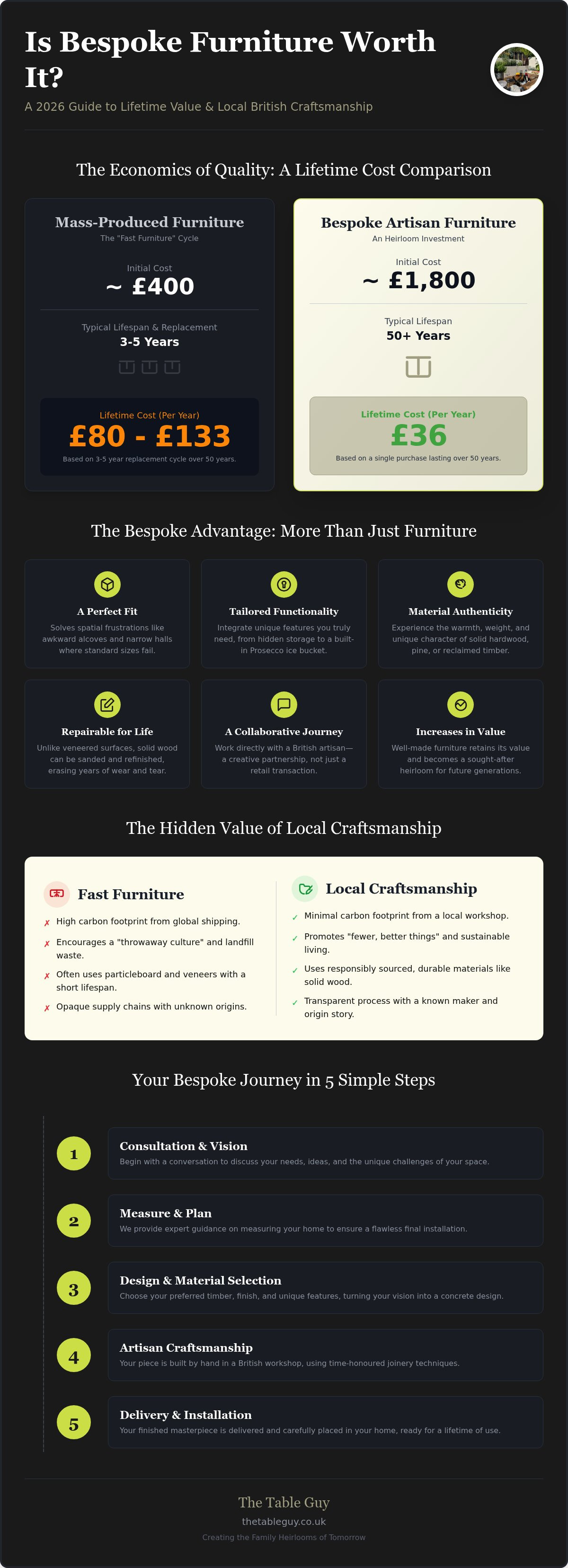
When you look at the price tag of a handmade table, it is easy to feel a moment of hesitation. Many homeowners ask themselves is bespoke furniture worth it when they compare artisan prices to high-street retailers. To find the real answer, you must look beyond the day of purchase. We encourage our clients to think about the "Cost per Year" rather than the initial outlay. A high-street table might seem like a bargain today. If it needs replacing in three years because the veneer has peeled or the cam-locks have loosened, that bargain becomes an expensive mistake.
Mass-produced items are often held together by metal fittings and particleboard. These materials don't handle the rigours of a busy British household well. Our solid wood joinery is different. It is designed to breathe and move with the timber. This ensures the structure remains rock-solid for decades. Artisan-made furniture also retains its value in a way that second-hand high-street brands simply cannot match. Whilst mass-market pieces often end up on the pavement, a well-made wooden table becomes a sought-after heirloom. To truly decide if is bespoke furniture worth it, you must consider the longevity of the materials involved. For high-traffic family kitchens, materials like our scaffold boards are particularly effective. They don't just survive the knocks of daily life; they gain character from them.
Material Matters: Hardwood, Pine, and Reclaimed Timber
Solid oak and bamboo are naturally resilient. They withstand daily wear far better than any veneered alternative. The most significant advantage is repairability. You cannot fix a deep scratch in a plastic-coated surface. With real wood, you can simply sand it back and refinish it. This ability to refresh the piece means it never has to look tired. For more details on selecting the right grain for your home, read our Material Spotlight: Choosing Wood for Your Hosting Table. Selecting the right material is the first step in ensuring your investment pays off.
The "Buy Once, Buy Well" ROI Framework
Consider a twenty-year furniture lifecycle. During this time, a homeowner might buy four separate mass-produced replacements as they break or go out of style. Alternatively, you can invest in a single bespoke piece that grows with your family. The logic is clear. In the context of British joinery, ROI is the measure of a piece’s ability to outlast its owner whilst retaining its structural and aesthetic integrity. If you're looking for a piece that truly earns its place, browse our workshop-crafted furniture to find your perfect fit.
Tailored Functionality: Solving the "Standard Size" Problem
British homes are rarely built with perfect symmetry. We often find ourselves living in spaces with stubborn alcoves, shallow bay windows, or hallways that feel just a few inches too narrow for standard high-street furniture. This is where the practical value of made-to-order pieces becomes undeniable. When you are trying to fit a hosting space into a Victorian terrace or a modern apartment with unusual angles, you begin to realise why is bespoke furniture worth it. It isn't just about style; it's about reclaiming every square inch of your floor plan.
Choosing a bespoke piece allows you to dictate more than just the length and width. You can select the exact leg style, such as industrial metal legs, to ensure the weight is distributed safely on your specific flooring. This level of detail prevents the common frustration of buying a beautiful item only to find it clashes with your skirting boards or blocks a vital walkway. Precision is key. For a deeper look at these design choices, see our Ultimate Guide to Designing a Custom Farmhouse Dining Table.
Designing for the Modern Host
Hosting should be effortless, yet standard tables often leave guests cramped or the host running back and forth to the kitchen. Our Prosecco dining tables solve this by integrating social functionality directly into the wood. By adding features like integrated ice buckets, the table stops being a passive surface and becomes a functional party centrepiece. Whether you need a specific length to comfortably seat ten people or a 12-seater for larger family gatherings, bespoke creation ensures nobody is left squeezed against a wall. It transforms the way you use your home. For those looking to create a dedicated entertainment hub, The Family Game Room provides premium examples of how specialised furniture can serve as both a social centrepiece and a functional gaming space.
When internal space is at its limit, many homeowners look to the garden to create extra room; for high-end, bespoke outdoor living structures, visit optisoul.co.
Storage is often the biggest casualty of "standard" furniture sizing. High-street sideboards and TV units frequently come in depths that either protrude too far into a room or leave wasted space behind them. If you have ever tried to fit a flat-pack unit into a sloping alcove, you already know the answer to is bespoke furniture worth it. Bespoke shelving and units allow for precise cable management and specific depths tailored to your modern electronics. This creates a streamlined look that mass-produced items can never achieve. Your soundbar and gaming consoles can sit flush without a tangle of visible wires. If you are struggling with an odd-shaped room, our Bespoke Shelving Units UK: The Ultimate Buying Guide provides the framework you need to start planning your storage.
Ethics and Environment: The Hidden Value of Local Craftsmanship
The environmental cost of a piece of furniture is often hidden beneath its surface. Whilst a high-street bargain might seem attractive, the ecological footprint of "fast furniture" is staggering. Most mass-produced items are shipped across oceans in vast container ships, contributing to significant carbon emissions before they even reach a UK warehouse. These items are frequently designed with a short lifespan in mind, leading to millions of tonnes of particleboard and plastic ending up in British landfills every year. When you ask is bespoke furniture worth it, the answer should include the health of the planet as well as the beauty of your home.
Choosing a "low-mileage" piece from a local British workshop changes the narrative entirely. Instead of supporting a global corporation with opaque supply chains, you are investing in a transparent process. Our workshop-to-home journey ensures that your furniture doesn't travel thousands of miles to reach you. This proximity reduces transport emissions and allows for a level of accountability that multinational retailers cannot offer. You aren't just buying a table; you are supporting a family-run ecosystem that values sustainability over sheer volume.
The Sustainability of Reclaimed Wood
Using materials like scaffold boards and reclaimed pine is a genuine win for the circular economy. These timbers have already served a purpose, and by giving them a new life as a dining table or shelving unit, we prevent them from being wasted. This process preserves the unique character and patina that only aged wood can provide. You get a piece with history etched into its grain, featuring knots and marks that tell a story. Artisan finishes also tend to be much kinder to your home environment. We use oils and waxes that contain fewer harmful chemicals than the industrial-grade lacquers found in mass-production factories, ensuring your indoor air quality remains high.
Supporting the British Craft Economy
There is a profound social value in preserving traditional joinery and metalworking skills within the UK. Every time you commission a piece, you help keep these vital crafts alive for the next generation. This supports a network of local suppliers, from the timber merchants to the small-scale metalworkers who help us create our industrial-style legs. There is a quiet pride in knowing exactly who built your furniture and where the materials were sourced. This transparency builds a sense of trust and community that is impossible to find in a flat-pack box. If you are ready to invest in a piece that respects both the environment and British heritage, view our handmade furniture collections today.
Commissioning Your Masterpiece: How to Start Your Bespoke Journey
Starting a commission might feel like a significant step, but it is actually a straightforward, rewarding partnership. We’ve refined the process into a simple five-step framework to help you move from an empty space to a finished centrepiece. First, define the primary use of your piece. Is it for daily family meals or grand hosting events? Second, measure your space with precision. Avoid using phone apps for this; a physical tape measure is essential. Third, enter the collaboration phase where you select your timber, leg styles, and finishes. Fourth, finalise your order and enter our workshop schedule. Finally, prepare for the arrival of a piece built specifically for you. When you consider the precision involved in this journey, you truly understand why is bespoke furniture worth it for your home.
Measuring is where most mistakes happen. We recommend leaving at least 90cm of "walkway" space around a dining table to allow chairs to be pulled out comfortably. If you have narrow doors or tight stairwells, tell your maker early. We can often design pieces like our farmhouse tables to be assembled on-site, ensuring a stress-free delivery. This collaboration ensures the final item fits your architectural reality perfectly. Whilst high-street retailers expect you to adapt to their stock, we adapt our craft to your room. This bespoke approach is the only way to guarantee a flawless fit in uniquely shaped British homes.
Lead times are a vital part of the artisan process. In 2026, typical lead times for high-quality British commissions range between 6 and 16 weeks. This duration reflects the time needed to source authentic materials and allow for the careful, multi-stage finishing process. We don't rush the wood. Quality joinery requires patience, and the result is a piece that remains stable and beautiful for a lifetime.
What to Ask Your Furniture Maker
Before you commit, ask about the origin of the timber and the specific durability of the finish. It's important to understand the difference between oil, wax, and lacquer. Oils and waxes offer a more natural, tactile feel and are easier to repair if a scratch occurs. Lacquer provides a harder seal but can be difficult for a homeowner to touch up. You should also ask about table extensions during this initial design phase. Even if you don't need them today, building a table that can accommodate extra guests in the future is a smart way to ensure your investment grows with your lifestyle.
From Workshop to Home: The Final Delivery
When your handmade piece arrives, it marks the beginning of a new chapter for your home. You will notice the weight and the solid feel of the joinery immediately. Maintenance is simpler than you might think. Because you chose real wood, a simple wipe with a damp cloth is usually all that is required. Every few years, a light application of fresh oil or wax will keep the grain looking vibrant. This repairability is a core reason why is bespoke furniture worth it; you aren't just buying a temporary object, but a future heirloom. Ready to begin? Explore our range of bespoke tables and start your project today.
Investing in the Heart of Your Home
Ultimately, deciding if is bespoke furniture worth it depends on how you value the next twenty years of your home life. It isn't just about the tactile beauty of solid wood or the social joy of our unique Prosecco tables with integrated cooling. It's about ending the cycle of fast-furniture waste and choosing sustainable reclaimed timber options that actually improve with age. You're moving away from temporary solutions and toward a legacy that grows with your family.
By partnering with our family-run workshop, established in 2014, you ensure every millimetre of your furniture serves a specific purpose. You gain a piece that fits your home’s unique dimensions perfectly whilst supporting the preservation of British craftsmanship. Your living space deserves a story and a sense of character that mass-produced items simply cannot provide. It is an investment in quality, ethics, and the simple pleasure of a well-made home.
Browse our handmade British furniture collections and discover how a single artisan piece can transform your daily life. We look forward to helping you create a functional masterpiece that stays in your family for generations.
Frequently Asked Questions
Is bespoke furniture more expensive than high-street brands?
Bespoke furniture typically requires a larger initial investment than mass-produced high-street brands. However, the true value lies in its longevity. Whilst a flat-pack item might last three years, an artisan piece is built for decades. You're paying for superior materials like solid hardwood and the skill of a master craftsman. This prevents the cycle of frequent, expensive replacements. It’s an investment in a permanent household fixture rather than a temporary object.
How long does it take to have a bespoke table made in the UK?
The typical lead time for a handmade table in the UK is currently between 6 and 16 weeks. This duration allows us to source the finest timber and give the wood the time it needs to settle. Rushing the process can compromise the integrity of the joinery and the final finish. Every stage, from the initial cut to the final coat of oil, is handled with meticulous attention in our workshop. We’ll keep you updated throughout the build.
Can I choose the specific type of wood for my custom furniture?
You have complete freedom to choose the timber that best suits your home’s character and your family’s needs. We offer a range of sustainable options, including durable scaffold boards, characterful pine, and modern bamboo. Each material has a unique grain and texture. Hardwoods like oak provide exceptional strength for high-traffic areas. During the design phase, we’ll guide you through the tactile differences and durability of each wood type to ensure your choice is perfect.
Is bespoke furniture worth it for a small home or flat?
Yes, is bespoke furniture worth it for smaller spaces because it allows you to utilise every available inch. Standard furniture often leaves awkward, wasted gaps in compact British flats. By commissioning a piece to your exact dimensions, you can fit a dining table into a shallow bay window or a sideboard into a narrow hallway. Custom sizing turns architectural challenges into functional storage. It creates a sense of order that mass-produced items simply cannot provide.
How do I maintain a handmade wooden table?
Maintaining your handmade table is remarkably simple. For daily cleaning, a soft, damp cloth is all you need to remove dust and spills. Avoid harsh chemical cleaners that can strip the natural finish. Every few years, you might choose to apply a fresh coat of wax or oil to keep the wood hydrated and vibrant. Because it’s solid wood, you can easily sand out minor scratches. This repairability ensures your investment looks beautiful for decades.
What happens if I need to move house with bespoke furniture?
Bespoke furniture is built to survive the rigours of moving. Unlike flat-pack items that often lose structural integrity once dismantled, our solid wood joinery remains robust. Many of our larger pieces, like farmhouse tables, can be designed for easy disassembly and reassembly. This ensures they can pass through tight doorways in your new home without damage. Your piece is a lifelong companion that adapts to your journey, wherever you choose to live next.
Are bespoke tables better for the environment?
Artisan tables are significantly better for the environment than global mass-market alternatives. We use low-mileage materials and sustainable timbers like reclaimed scaffold boards, which reduces the carbon footprint of your purchase. By building for longevity, we help break the cycle of fast furniture that fills British landfills. Supporting a local workshop also means your furniture hasn't been shipped across oceans. It’s a choice that respects both traditional skills and our planet’s resources.
Can I add custom features like ice buckets to any dining table?
We specialise in integrating unique social features into our designs. You can add integrated ice buckets to our Prosecco dining tables or request specific cable management for your TV units and sideboards. These features are built directly into the structure during the workshop phase. It transforms a standard piece into a functional centrepiece tailored to your lifestyle. Whether you need extra shelving or a specific leg style, we work with you to make the piece truly yours.


Comments