
Removable leaf dining tables for different room layouts
The most practical dining table for a small room may not be the smallest one. A removable leaf dining table stays compact for everyday meals and gains extra tabletop space when you fit a separate leaf.
It’s easy to confuse this design with a drop-leaf table, where hinged sections fold down when they’re not needed. Both adapt to changing room layouts, but their leaves work differently. The table’s base and supports also affect how comfortably people can sit around it.
Choosing well means looking beyond the table’s closed dimensions. Consider how the leaf works, how the table’s shape and size affect chair placement, and whether there’s enough clearance when it’s extended. Base styles and leaf supports can also affect seating and movement. Thinking about how you use the room each day helps you choose a table that fits.
Table of Contents
Shapes and table footprints
Shape affects how a table fits, where chairs sit and how people move around it. Compare its outline in everyday use and with the leaf fitted.
Choosing a table shape
A round table has no corners, making it easier to move around in a compact dining area. The NHS recommends round tables for dining areas seating four to five people. Its central point also gives diners a shared view, while the curved edge changes how chairs are spaced.
A rectangular table suits a long room or a dining area beside a wall. Its straight sides can align with the room’s length, and an end seat can provide an extra place when needed. An oval table keeps a longer layout but softens the corners, which can help preserve a clear route past its ends.
A square table creates a balanced footprint in a square room. Before choosing, picture where each chair will sit, not just the tabletop outline. For example, a rectangular top may suit a narrow room better than a round one, even if both serve the same dining purpose.
Comparing table footprints
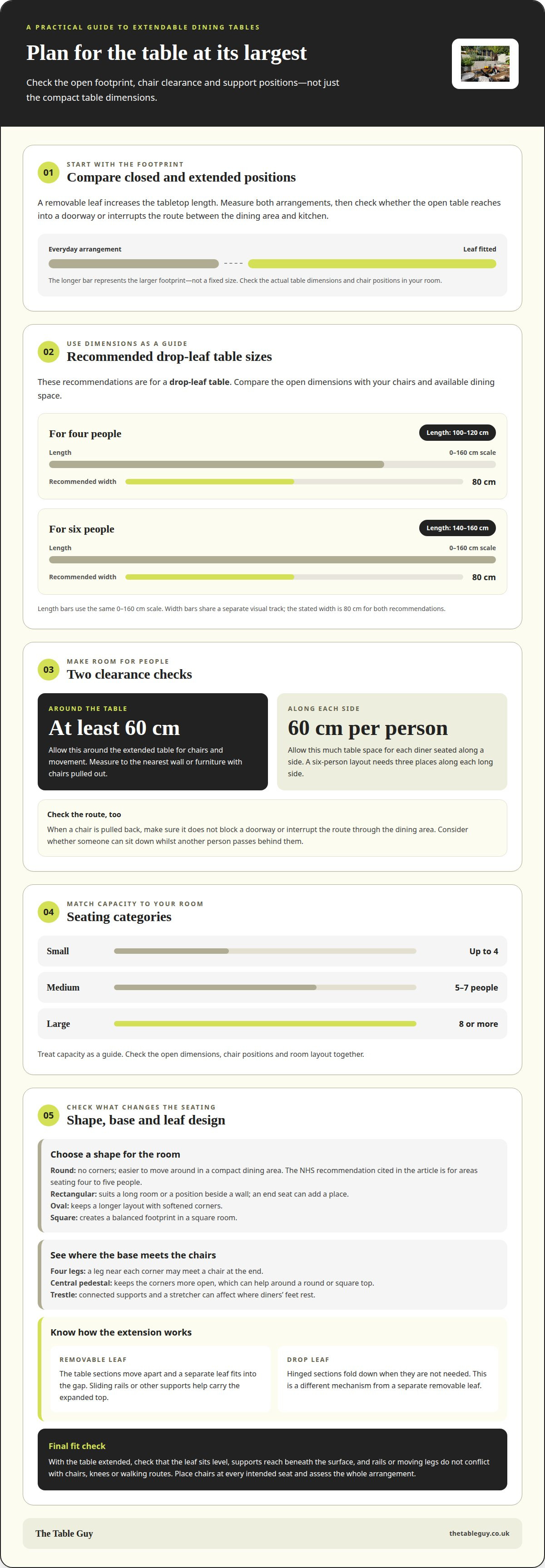
Measure the space the table occupies in both its compact and extended arrangements. A removable leaf increases the tabletop length, so the room needs to accommodate the open footprint as well as the closed one. For a rectangular or oval design, check whether the added length reaches into a doorway or interrupts the route between the dining area and kitchen.
Round and square tops use space differently from long tables. Their widest point spans the room, while a rectangular table concentrates its footprint along one axis. Sketch each shape on paper or mark its outline on the floor to see whether chair positions conflict with nearby furniture.
Consider the base as part of the footprint. A central pedestal may leave the corners clear, while legs near the edges can affect chair placement. Match the tabletop shape to the room’s walkways, then assess the base and seating positions together. This shows whether the table works beyond its outline alone.
Table dimensions and chair clearance
Measure the table in both its everyday and extended positions. Then allow for occupied chairs and a clear route around it.
Sizing the table
Check the table’s height against your chairs before choosing it. Check the tabletop’s length and width as well as its height. A drop-leaf table extending to 100-120 cm long and 80 cm wide is recommended for four people. For six, a length of 140-160 cm and an 80 cm width is recommended.
These measurements help you compare the open table with your room. Measure both positions, including any change in width. A table’s listed seating capacity is a guide, not a substitute for checking how its dimensions fit your chairs and dining space.
Allowing chair clearance
Allow at least 60 cm around an extended dining table for chairs and movement. Measure from the table edge to the nearest wall or furniture, with chairs pulled out. This reveals whether someone can sit down whilst another person passes behind them.
For diners seated along each side, allow 60 cm of table space per person. A six-person layout, for example, needs room for three places along each long side. Consider the room’s walkways too. A chair pulled back should not block a doorway or interrupt the route through the dining area.
Matching capacity to the room
Use seating categories to narrow your options: small tables seat up to four, medium tables seat five to seven, and large tables seat eight or more. Compare the category with the number of places you need when the table is extended. Then check whether the open dimensions and chair positions fit the room together.
Considering table and chair materials
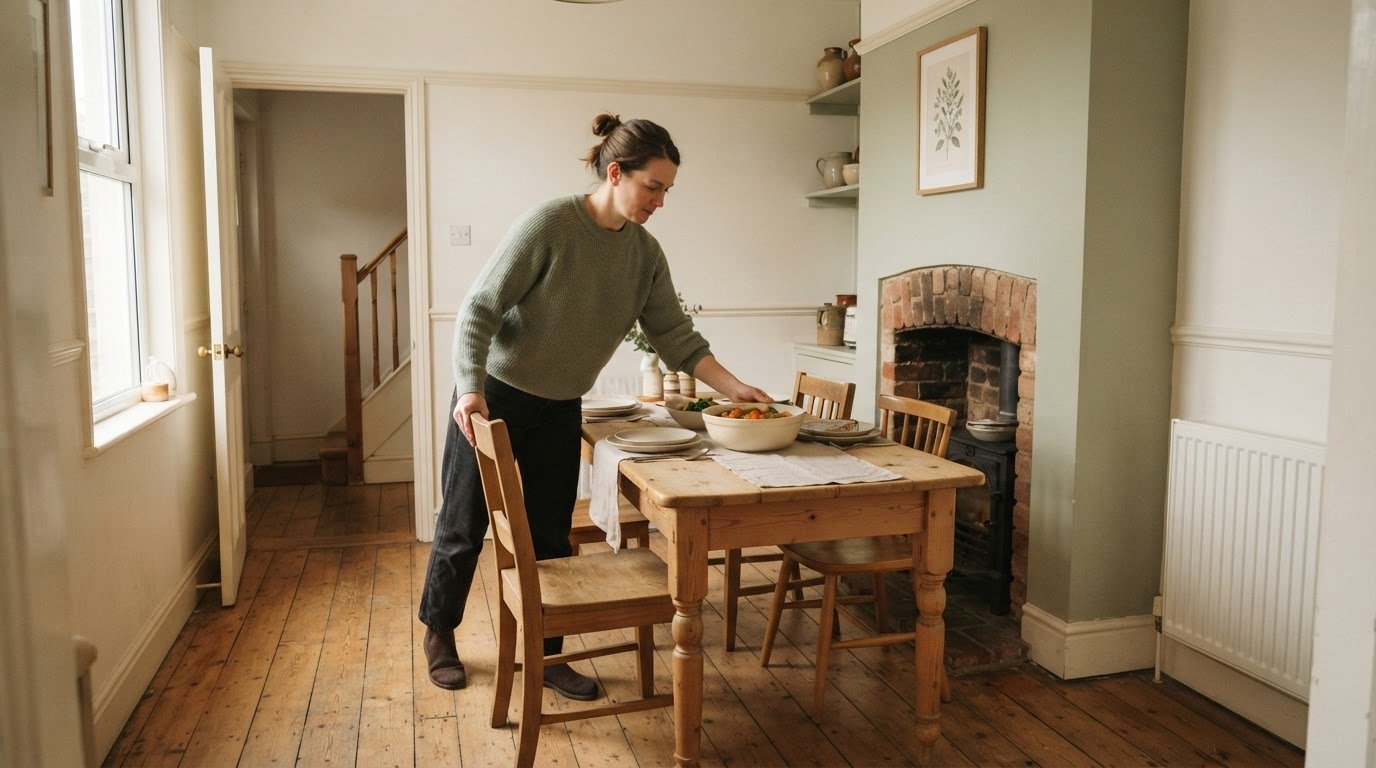
Wooden tables and chairs create a consistent material feel, while metal chairs contrast with a timber top. Material also affects a chair’s shape and how it sits beneath the table edge. For example, an armchair needs more space than a simple chair. Compare the chair’s arms, legs and seat height with the table dimensions before settling on a layout.
Base and leaf-support designs
The base affects where chairs can sit, while leaf supports carry the extended top. Assess both together: a spacious tabletop can still feel awkward if legs or support rails take up useful seating space.
How the base changes seating
A four-leg base places a leg near each corner. This can suit a rectangular table, but a chair near an end may meet a leg. Check the chair positions, not simply the number of places advertised.
A central pedestal keeps the corners more open, which can help with seating around a round or square top. A trestle base uses supports connected by a stretcher. This can give a long table a strong visual framework, though the supports may affect where diners’ feet rest. Compare these layouts with your usual chair positions.
How the leaf is supported
With a removable centre leaf, the table’s two sections move apart before the leaf fits into the gap. Sliding rails beneath the top help guide and support the sections. In other designs, the leaf rests on extending rails or additional supports. Check where the table bears weight once extended, as the details vary.
Look at the underside as well as the tabletop. A support rail may run beneath the edge where a diner’s knees need room. A leg that moves with an extension may also change the available seating positions. These details matter most at the table ends, where chairs often meet the base.
What to assess before choosing
Compare the closed and extended arrangements. Check whether the base stays centred, the leaf sits level and the supports reach beneath the expanded surface. Then place chairs at each intended position. A simple floor plan can show whether a support conflicts with a chair or walking route.
The best design balances a stable-looking extended top with practical legroom. Judge the complete arrangement, including the leaf, base, rails and chairs. That gives a more useful picture than choosing by tabletop shape alone.
Table extension types, including removable leaves
Extension designs add dining space in different ways. The key distinction is whether a section comes away, folds down or stays stored inside the table.
Removable leaves and stored extensions
A removable leaf is a separate panel fitted between the tabletop sections. To extend the table, move the sections apart, fit the leaf into the gap, then bring the top together around it. To make the table compact again, remove the panel and bring the sections together.
Some tables store an extension leaf inside the table; others require separate storage. That difference matters in a smaller home. Before choosing, consider where the loose panel will go and whether you can handle it comfortably. A separate leaf also needs protection while stored away.
With a butterfly leaf, the extension folds and is stored beneath the tabletop. This keeps the leaf attached to the table, rather than requiring separate storage space. The mechanism differs from a removable panel, so check how the leaf is supported and fits into place.
How drop-leaf tables fold and extend
A drop-leaf table has hinged sections at one or both sides. Lower a leaf to reduce the tabletop; raise it when you need more room. Supports beneath the raised section hold it in position. Unlike a removable-leaf design, it doesn’t use an extra panel to fill a central gap.
Folded drop-leaf tables can measure under 30 cm deep. In the cited range, widths start around 30 cm folded and reach up to 150 cm when opened. Drop-leaf table heights are mostly 75 to 76 cm, and some designs seat two to six people, depending on size.
Choose according to how the table will change your layout. A drop leaf can reduce its footprint at the side; a removable insert extends the top through its centre. For a closer look at extension options, explore table extension choices and consider which arrangement suits your room.
The Table Guy: Prosecco Dining Tables
The Table Guy offers made-to-order dining tables in a range of styles and materials. Options include Prosecco Dining Tables, Farmhouse Tables, Bamboo & Hardwood Tables, and Scaffold Board & Pine Tables, crafted in its UK workshop.
Consider The Table Guy when you’ve thought about your room layout, seating needs and preferred table style, and want a bespoke piece for your home. Start with how you use the room, whether for everyday meals, shared gatherings, or both. Discuss the style, material and dimensions that suit your dining area.
Contact The Table Guy to discuss a dining table for your space.
Make the table part of your home
A dining table is more than a place to gather. It becomes part of the room’s daily rhythm, from quiet breakfasts to long conversations over a meal. As you decide what belongs in your home, consider the atmosphere you want as well as the practical fit. A removable leaf dining table offers flexibility, while its materials and character help shape the room.
The Table Guy offers made-to-order Prosecco Dining Tables, Farmhouse Tables, and Bamboo & Hardwood Tables. Consider which style feels right for your space, then request a quote to start planning a table that suits your household and taste.
Contact The Table Guy to discuss your dining table ideas. Your next gathering can start with a piece chosen thoughtfully for the home you share.
Frequently Asked Questions
What is a removable leaf dining table and how does it work?
A removable leaf dining table has a separate panel that increases the tabletop’s length. The table sections move apart, the leaf fits between them, and the sections close against its edges. Remove the panel to return the table to its compact arrangement. Unlike a drop-leaf design, it doesn’t rely on hinged sections that fold down at the sides.
What sizes are removable leaf dining tables when extended and closed?
There isn’t one standard closed or extended size; dimensions depend on the design and the leaf. Compare the full length and width in both arrangements, rather than assuming a leaf adds a particular amount. Drop-leaf tables provide a useful comparison, with some measuring under 30 cm deep when folded and reaching up to 150 cm when opened. Those figures don’t define removable-leaf tables.
How many extra seats can a removable leaf dining table accommodate?
The extra seating depends on the leaf’s length, the table’s shape and the position of its legs. A panel may create room for another place at each end or add space along the sides, but it doesn’t guarantee a fixed number of seats. For a realistic plan, map the chairs you intend to use around the extended top and account for the base.
What materials and finishes are available for removable leaf dining tables?
Material options include oak, pine, reclaimed wood and bamboo, as well as metal details. The Table Guy makes bespoke dining tables using these materials, with adjustments to size, shape and finish. A stain or colour changes the table’s appearance, while the underlying material shapes its character. Choose a finish that works with your room and the look you want over time.
What should you check for durability, stability and ease of assembly before buying?
Look for close-fitting joints between the leaf and tabletop, a level surface when extended, and supports that sit securely beneath the added section. Check that the base doesn’t shift as the table opens or closes. Consider how the leaf is stored and handled, too. Clear assembly instructions and accessible fittings can make setup simpler, especially if the table needs to be moved.
What are the different types of removable leaf dining tables?
Options include a separate removable centre leaf, fitted between the tabletop sections, and a butterfly leaf, which folds and stores beneath the tabletop.
Comments