
Solid Oak Furniture: The Ultimate Guide to Bespoke Quality vs Mass-Market Retail
- Jezz Leazell
- 3 days ago
- 13 min read
Why does that "bargain" oak table from the high street start to wobble before you've even finished your first Sunday roast? It's a common frustration for many UK homeowners who find themselves stuck in a cycle of replacing flimsy furniture every few years. You deserve a home that feels authentic and warm, filled with sturdy pieces that actually fit the dimensions of your living room rather than just "making do" with flat-pack alternatives.
We understand that choosing the right furniture is a significant decision. You want something that lasts. In this guide, we'll show you why solid oak furniture remains the undisputed gold standard for British households. You'll learn how to distinguish genuine artisan craftsmanship from clever mass-market imitations that rely on thin veneers and hidden staples. We'll also explore the secrets of traditional joinery and how bespoke, made-to-order pieces provide the longevity your home deserves. By the end, you'll know exactly how to spot a "forever" piece that will stand the test of time and become a cherished part of your family's history.
Table of Contents
What is Solid Oak Furniture and Why Does it Command Respect?
When you run your hand across a bespoke table, you aren't just touching wood; you're feeling centuries of British heritage. True solid oak furniture is defined by its construction from the Quercus robur species, or its close relatives, where every single component is cut from the heart of the tree. This isn't the hollow, lightweight material you find in flat-pack boxes. It’s the same timber that built the English naval fleet and supported the roofs of our greatest cathedrals. Choosing oak is a nod to a time when things were built to last forever. Every piece carries its own story through unique grain patterns, deep knots, and subtle colour variations that only nature can provide. We call this "character," and it's what makes your furniture entirely yours.
Owning a legacy piece creates an emotional connection that mass-market retail simply cannot replicate. These items become part of your family's narrative, surviving house moves, growing children, and decades of Sunday roasts. They don't just occupy space; they anchor a room with a sense of permanence and authenticity. When you choose solid timber, you're buying a piece of the natural world that has been carefully shaped by human hands.
The Biological Advantage: Density and Tannins
Oak trees are notoriously slow growers. This patience results in incredibly tight growth rings and a high density that makes the timber feel heavy and substantial. Beyond its weight, the properties of oak wood include a high concentration of natural tannins. These chemical compounds act as a built-in defence system, protecting the wood from fungal rot and insect attacks for decades. In a busy family home, this biological resilience is vital. It’s why oak is the superior choice for heavy-use items like dining tables that need to withstand spills, heat, and the general bustle of daily life without losing their structural integrity. It's tough. It's reliable. It's built for real life.
The Sustainable Choice for UK Homes
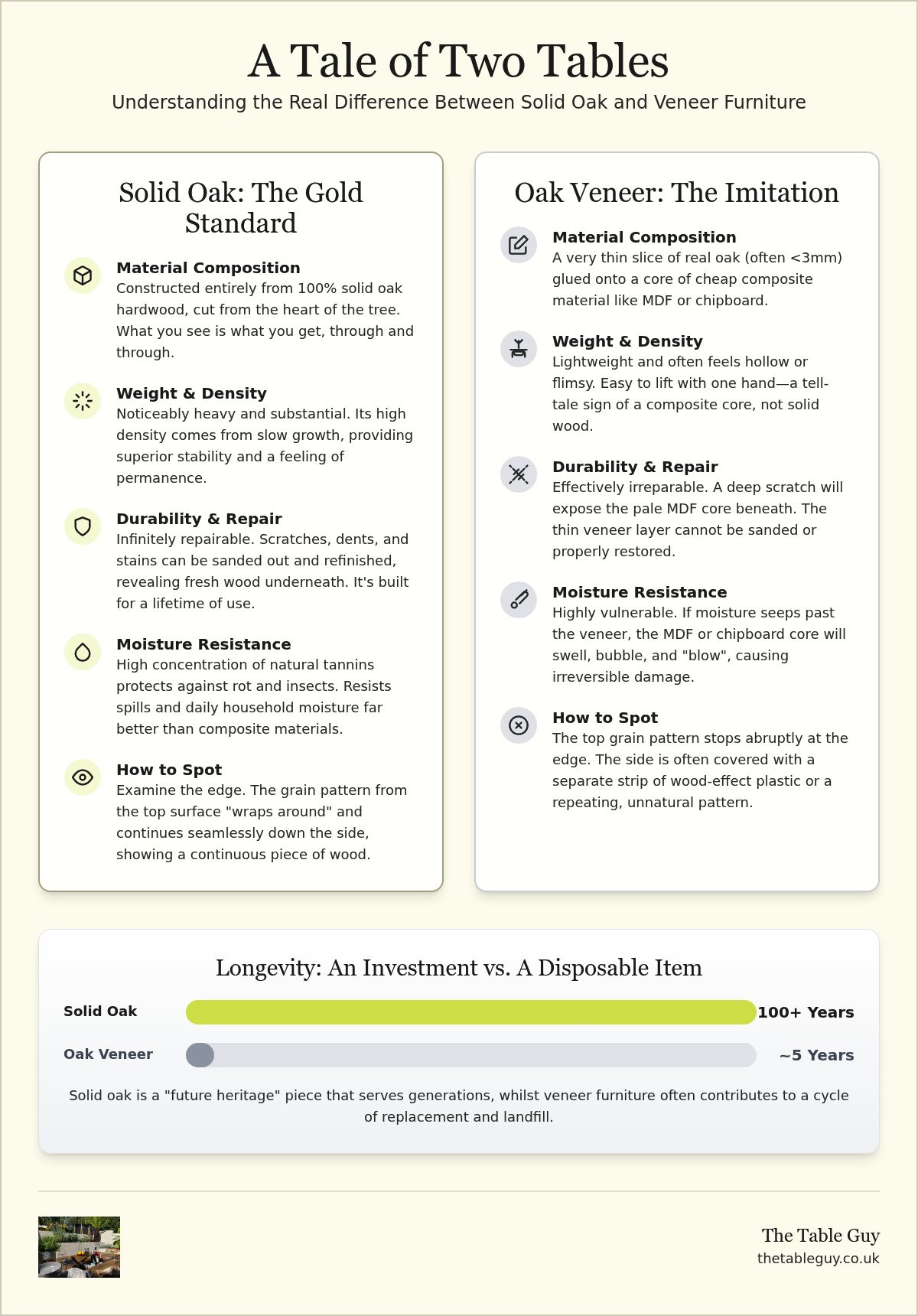
Investing in quality means you stop participating in the "throwaway" culture of modern retail. A piece of solid oak furniture can easily last 100 years or more, whereas mass-produced alternatives often end up in a landfill within five. This longevity is the ultimate form of sustainability. Long-lived wooden furniture acts as a carbon store, keeping CO2 locked away for generations. By choosing a piece hand-crafted in a UK workshop, you also significantly reduce "furniture miles." You aren't shipping MDF across oceans; you're supporting local artisans who value material authenticity and environmental responsibility. It's a choice that feels as good for the planet as it does for your home.
Solid Oak vs. Oak Veneer: A Technical Comparison
Pick up one corner of a high-street coffee table. If it lifts with a single finger, you're likely dealing with a clever imitation. The "weight test" is the most immediate way to distinguish genuine solid oak furniture from mass-market alternatives. Real oak is dense, heavy, and carries a structural presence that composite materials simply cannot mimic. Whilst mass-market retailers often use the word "oak" in their marketing, a closer look at the price tag and the weight usually reveals a different story. True quality feels substantial to the touch.
Technically, most high-street pieces are constructed using oak veneer. This involves gluing a wafer-thin slice of real wood, often less than 3mm thick, over a core of Medium Density Fibreboard (MDF) or chipboard. To understand the structural differences between solid wood vs. engineered materials, one must look at how they handle wear. If you scratch a veneer, you expose the ugly grey pulp beneath it. If you scratch solid oak, you simply find more oak. This makes solid timber infinitely repairable; you can sand it, refinish it, and bring it back to life decades later. You can't do that with a sticker on a board.
There is a simple secret to spotting the difference: check the end-grain. On a genuine solid piece, the grain patterns on the top of the table should naturally "wrap" around the edge and continue down the side. In mass-produced veneer furniture, the grain on the top often stops abruptly, or the edges are covered with a separate strip of wood-effect plastic. It’s a small detail, but it’s the hallmark of material authenticity.
Durability and Resistance to Daily Life
Solid oak is remarkably resilient to the chaotic nature of a busy household. It handles the occasional spill or the warmth of a mug much better than composite boards, which tend to swell and "blow" when moisture seeps into the MDF core. Over time, real wood develops a rich patina, deepening in colour and character as it ages. Checking is the natural, non-structural movement of solid wood as it breathes with your home's environment. Unlike veneer, which eventually peels and cracks at the corners, solid oak stays structurally sound for a lifetime.
The Real Cost of "Cheap" Alternatives
Many people view bespoke furniture as a luxury, but the maths often tells a different story. Consider a high-quality oak table costing £1,500. If that table lasts 50 years, your "cost per year" is just £30. Contrast this with a £500 veneer table that needs replacing every five years due to wobbles or peeling edges. Over that same half-century, you would spend £5,000 on "cheap" tables. For busy families, veneer is often a false economy. Investing in a "forever" piece means you only buy it once. If you want to see how we build for longevity, you can browse our range of handmade dining tables to find a style that suits your space.
Artisan Workshop vs. High-Street Retail: Where to Buy?
Walking into a high-street showroom often feels like a race against volume. You are met with thousands of "in-stock" items designed for immediate delivery, yet these pieces are rarely a perfect fit for your home. When you choose an artisan workshop, you're opting for a commissioned experience rather than a simple off-the-shelf transaction. It's a partnership between you and the maker. Whilst mass production relies on rigid, standardised designs, a bespoke approach allows every piece of solid oak furniture to be tailored to your specific lifestyle. You aren't just a number in a database; you're part of the creative process.
There is also the vital issue of transparency. High-street chains often operate through opaque global supply chains where it’s difficult to know where the timber was harvested or who actually built the piece. In a UK-based workshop, the process is open. You know exactly whose hands have shaped your table. We understand that lead times can be a concern in a world of "fast furniture." However, waiting for quality is a virtue. A table built in a global factory is prioritised for shipping efficiency, which often leads to thinner components. A local craftsman prioritises structural integrity. That extra time ensures the timber is seasoned correctly and the joinery is flawless.
The Power of Bespoke Sizing
Standard 6-seater tables often fail in the uniquely shaped dining rooms found in many British homes. Perhaps your room is slightly too narrow for a retail model, or you have an awkward alcove that requires a specific length. Bespoke sizing removes these compromises entirely. You gain the freedom to choose leg styles, edge profiles-such as a rustic live edge or a clean straight cut-and specific finishes. If you want to anchor your living room with a similar level of customisation, our guide to bespoke coffee tables uk explains how tailored dimensions can transform the flow of your home.
Quality Control and Traditional Joinery
The true strength of a piece lies in its bones. Mass-produced furniture typically relies on cam-locks, staples, and plastic brackets designed for quick assembly. Artisan makers use traditional techniques like mortise and tenon joints, which provide incredible mechanical strength. Every board is hand-selected. A craftsman will spend hours grain-matching the timber so the natural patterns flow beautifully across the surface. This level of meticulous detail ensures your solid oak furniture remains sturdy and silent, never developing the wobbles associated with flat-pack alternatives. It's built for the long haul.
Choosing the Right Style for Your Home
Oak is frequently pigeonholed as a purely rustic material suited only for country cottages. This is a common misconception. In reality, solid oak furniture is incredibly versatile, capable of anchoring a sleek urban flat just as effectively as a charming country cottage. The key lies in the silhouette and the finish you choose. By moving away from mass-produced designs, you gain the freedom to select an aesthetic that reflects your personality rather than following a retail trend. It’s about creating a space that feels intentional.
There are three primary aesthetics to consider when commissioning a piece. Farmhouse style remains a favourite for its chunky, rugged presence and sense of history. Industrial designs pair the warmth of oak with raw metal frames for a modern, urban edge. Contemporary styles lean towards Scandi-inspired minimalism, featuring slimmed-down proportions and clean, tapered legs. If you want to preserve the tree's original silhouette, a "Live Edge" finish keeps the natural contours of the bark intact. This creates a striking, organic centrepiece that feels like a piece of art in your dining room.
The finish you select also changes the wood’s behaviour and appearance. An oiled finish provides a tactile, matte surface that lets you feel the grain under your fingertips. It requires a little more care but ages beautifully. Lacquer offers a hard-wearing shield against spills, whilst wax provides a traditional, soft satin glow. Oak’s neutral honey tones allow it to bridge different eras, making it easy to mix with existing walnut or pine pieces without clashing. You don't have to start from scratch to introduce quality timber into your home.
The Farmhouse vs. Modern Aesthetic
Traditional farmhouse tables are all about substance. They feature thick tops and heavy, supportive bases that invite people to gather around for hours. In contrast, a modern aesthetic prioritises light and space. Straight edges and shadow gaps create a sense of weightlessness even when using dense timber. Oak’s neutral honey tones allow it to bridge different eras effortlessly, ensuring your new table feels at home amongst both antique cabinets and modern kitchen units.
Functional Additions and Custom Features
Bespoke making allows for the creation of "Hosting Tables" that go beyond simple dining. We can integrate unique features like built-in ice buckets for social gatherings or hidden table extensions that slide out seamlessly for Christmas dinner. These functional elements are designed into the structure from the start, ensuring they don't compromise the table's strength. For those looking to extend this aesthetic to the patio, a bespoke metal garden table uk offers a durable way to pair oak-style aesthetics with weather-resistant frames. Ready to design your perfect piece? You can view our full range of bespoke tables to see how we can bring your vision to life.
The Table Guy: Hand-Crafting Your Future Heritage
At The Table Guy, we don't believe in assembly lines. Since 2014, our family-run UK workshop has been a sanctuary for traditional skills and material authenticity. We embrace the "Passionate Artisan" philosophy; this means we treat every commission as a unique partnership with you. When you choose solid oak furniture from our workshop, you aren't just buying a product. You are commissioning a piece of future heritage. Our process is simple and personal. It begins with your initial enquiry, where we discuss dimensions, finishes, and specific features. From there, we hand-select the timber and begin the meticulous build. There are no mass-produced shortcuts here. Just honest, hard-wearing timber shaped by people who care about the result.
We take immense pride in our local heritage. Every piece we create is built-to-order, ensuring that the durability of our solid oak furniture meets the high standards our customers expect. We invite you into the physical space where the work happens, metaphorically and literally, by keeping you updated on your table's progress. It is a journey from raw timber to a finished centrepiece that will anchor your home for decades. We value connection, storytelling, and the preservation of skills that are slowly being lost to global mass-market retail.
More Than Just a Table: A Hosting Experience
Our signature Prosecco tables, featuring integrated stainless steel ice buckets, have become a hallmark of our workshop's innovative spirit. These designs are about more than just aesthetics; they are about the experience of hosting. We believe the dining table should be the social hub of the home, a place where conversations flow as easily as the drinks. Beyond our tables, we apply the same artisan dedication to our sideboards, TV units, and consoles. If you are looking to organise your space with the same level of craftsmanship, our guide to bespoke shelving units uk explores how custom storage can complement your solid wood aesthetic.
Why Choose a UK Workshop in 2026?
Supporting local skills is more important now than ever. By choosing a UK workshop, you ensure your furniture is built to withstand the specific nuances of the British climate. Wood is a living material that breathes. We understand how to season and treat oak so it remains stable in our unique environment. The personal connection is also vital. You can speak directly to the person building your table, ensuring every detail is exactly as you imagined. A piece from The Table Guy isn’t just furniture. It’s a story in wood. It’s a commitment to quality that you’ll feel every time you sit down for a meal. Choose quality. Choose heritage.
Bring Home an Heirloom That Lasts a Lifetime
Choosing solid oak furniture is about more than just filling a room; it's about making a commitment to quality and heritage. We've explored how genuine timber outlasts flimsy high-street veneers and why the "weight test" never lies. By opting for a commissioned piece, you gain a table that fits your home's unique dimensions and your family's specific needs. Whether you're hosting a grand Sunday roast or an intimate evening around one of our signature Prosecco tables, you're investing in a centrepiece that will only get better with age.
Since 2014, our family-run UK workshop has rejected the shortcuts of mass production in favour of traditional joinery and dedicated craftsmanship. Every knot and grain pattern in our hand-crafted collection tells a story of material authenticity and local pride. It's time to move away from the cycle of disposable furniture and choose a piece that truly belongs in your space. Explore our hand-crafted solid oak collection and start your bespoke journey today. We look forward to welcoming you into our community of owners and building something truly special for your home.
Frequently Asked Questions
How can I tell if a piece of furniture is real solid oak or just veneer?
Check the end-grain on the edges of the table to see if the grain pattern continues naturally from the top surface down the side. In solid oak furniture, the grain "wraps" around the corner because it's a single piece of timber. Veneered pieces often have a separate strip of wood or plastic on the edge where the grain stops abruptly. You can also feel the weight; real oak is significantly heavier than MDF-cored imitations.
Does solid oak furniture scratch easily, and can it be repaired?
While oak is a very hard timber, it can still be scratched by sharp objects or heavy use. The beauty of solid wood is that it's entirely repairable. Unlike veneer, which has a thin surface that peels if damaged, solid timber can be sanded down and refinished. You can simply apply a fresh coat of oil or wax to make a scratch disappear. It’s a material that actually benefits from a little maintenance over the years.
Why is solid oak so much more expensive than pine or MDF?
Oak is a slow-growing hardwood that takes decades to mature, resulting in a much higher density and natural durability than fast-growing softwoods like pine. It contains natural tannins that protect it from rot and insects, which composite materials like MDF lack. You're paying for a material that lasts for a century. When you consider that you won't need to replace it every few years, the long-term value is much higher.
How do I maintain my solid oak table to ensure it lasts a lifetime?
Keep your table clean with a soft, damp cloth and avoid using harsh chemical sprays that can strip the natural oils. It's best to use coasters for hot mugs and placemats for plates to prevent heat marks or moisture rings. Depending on the finish, we recommend applying a fresh coat of furniture oil or wax every 12 to 18 months. This simple routine keeps the wood nourished and the grain looking vibrant.
Can I have solid oak furniture made to fit a specific small space?
Yes, the "built to order" nature of our workshop means we can tailor every dimension to your specific needs. Many UK homes have awkward alcoves or narrow dining rooms that don't suit standard high-street sizes. We can adjust the length, width, and even the leg height to ensure your piece fits perfectly. You don't have to settle for something that's "nearly right" when you choose a bespoke commission.
Is solid oak furniture sustainable and eco-friendly?
Solid timber is one of the most sustainable choices you can make because of its incredible lifespan. A single oak table can serve a family for over 100 years, preventing the waste associated with "fast furniture" that ends up in landfills. It also acts as a natural carbon store. By choosing a UK-based workshop, you're also reducing the environmental impact of global shipping and supporting local, responsible timber sourcing.
What is the difference between European oak and American oak for furniture?
European oak, such as Quercus robur, tends to have a more rustic character with varied grain patterns and a slightly darker, warmer tone. It’s the traditional choice for British heritage furniture. American oak is often straighter-grained and more uniform in colour, which some prefer for very modern designs. We favour the rich texture and local history of European oak for our handmade tables because it feels more authentic.
Will my solid oak furniture change colour over time?
Yes, all natural timber mellows and shifts in tone as it is exposed to sunlight and the environment. This process is called developing a "patina," and it's a hallmark of genuine quality. Your oak piece will likely deepen from a pale honey colour to a richer, warmer amber over the first few years. This change is subtle and adds to the story of the piece as it ages gracefully alongside your family.


Comments