
Family Heirloom Quality Dining Table: A Thoughtful UK Buying Guide
What makes a family heirloom quality dining table? It is not just a polished finish, but how well the table serves Sunday lunch, homework and the years in between. A beautiful surface may catch your eye, but it won’t tell you whether the construction feels dependable or the size will work for everyday family life.
It’s natural to want a table that feels special, especially when it’s a considered investment. Look beyond appearance and weigh practical signs of lasting quality against the way your household uses the room. This guide covers materials and construction, choosing a shape and size to suit your space, and details such as finish and extensions as family needs change.
We’ll also look at what to consider when commissioning a made-to-order table, from setting out your requirements to choosing options that feel right for your home. The Table Guy is a family-run furniture maker established in 2014, crafting bespoke furniture in a UK workshop. A table designed around real life can become more than a place to gather: it can be part of family life for years to come.
Table of Contents
What makes a family heirloom quality dining table worth keeping?
Which construction details help a dining table stand the test of time?
How do materials and design choices compare for long-term family use?
How should you specify a dining table for your room and family?
Why commission a bespoke family heirloom quality dining table?
What makes a family heirloom quality dining table worth keeping?
“Heirloom quality” is a description to assess, not a label to accept at face value. A family heirloom quality dining table earns that description through durable construction, considered materials, useful design and the ability to remain relevant as a household changes. Look for a piece that feels purposeful as well as attractive, with details that support the way you’ll use it.
Heirloom-quality furniture is thoughtfully made to serve everyday needs over time, with enduring construction, practical design and personal meaning.
Age alone doesn’t prove lasting quality, and a high price isn’t a guarantee of it. Nor does a distressed finish automatically suggest a long history or robust build. Look instead at what lies behind the appearance: how the parts are joined, whether the table feels stable, how the finish suits its intended use and whether its proportions make sense in your home. These are more useful clues than a label or an impression of weight.
Is heirloom quality more than solid wood?
Solid wood can bring natural variation and a substantial feel, but the material alone won’t tell you whether a table is well designed or suited to your household. The base, connections and proportions matter too. A poorly balanced table may wobble, while an appealing material won’t compensate for a finish that doesn’t fit the way you plan to use the surface.
Notice how the top and base meet, and whether the table feels steady under ordinary use. Different Woodworking Joints connect components in different ways, so understanding their role can help you look beyond appearance. No one material is automatically the best choice: assess the complete table in context, including its finish, design and expected daily use.
Why family use should shape the definition
Picture a typical week. The table might host shared meals, become a place for homework, then make room for a celebration at the weekend. Those routines call for more than an attractive centrepiece. Consider whether the surface and overall design suit the way your family gathers, works and moves around the room.
Useful design helps a table remain part of family life rather than becoming too precious to use. A finish that suits everyday routines, a shape that welcomes people around it and proportions that work with your chairs can all help it stay relevant. Scuffs and marks may accumulate through use. They aren’t proof of quality, but neither does a pristine appearance define it.
Heirloom potential comes from a combination of sound making, regular care and the memories formed around the table. Its value may be practical as well as sentimental: a dependable place to eat, talk, study and celebrate. Choose for the life you have, while considering whether the design can continue to serve you as that life changes.
Which construction details help a dining table stand the test of time?
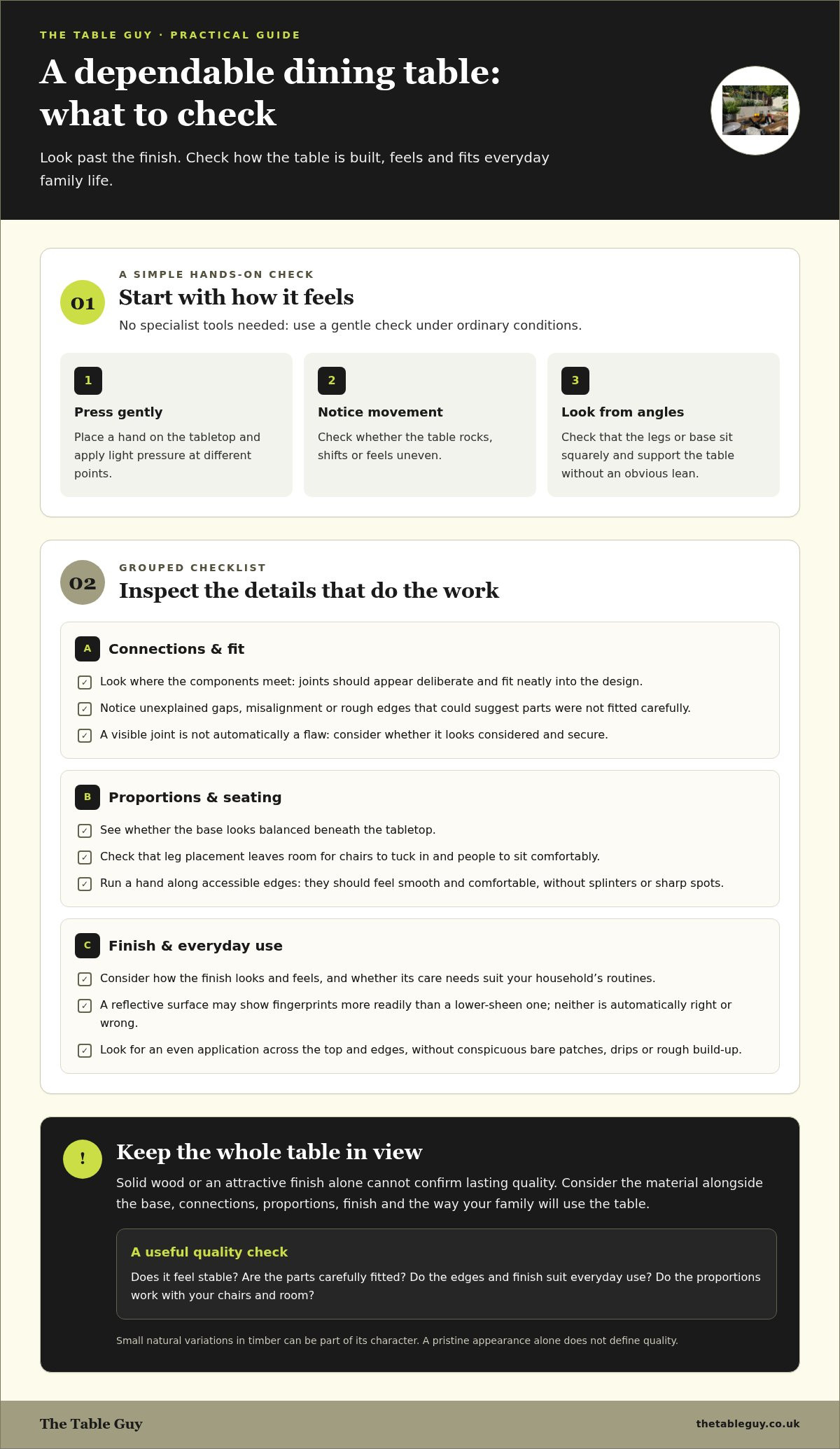
A well-made dining table should feel composed and dependable, not simply look substantial. Look at the whole piece: a base that supports the top evenly, secure and neatly aligned connections, comfortable edges, balanced proportions and a finish suited to daily use. A well-made dining table feels stable, has carefully fitted parts and a consistent finish, with every detail working together for its intended use.
How to assess stability, joints and everyday usability
Start with a gentle check under ordinary conditions. Place a hand on the tabletop and apply light pressure at different points. Notice whether it rocks, shifts or feels uneven. Look at the legs or base from more than one angle. They should sit squarely, support the table without an obvious lean and leave enough room for people to sit comfortably.
Next, inspect where the components meet. Joints should look deliberate and fit neatly into the design, rather than showing unexplained gaps, misalignment or rough edges. A visible joint isn’t automatically a flaw: it may be part of the table’s character. What matters is whether it looks considered and secure, or suggests that parts haven’t been fitted carefully. FIRA, the Furniture Industry Research Association (FIRA), supports research and standards across the furniture supply chain, offering useful context for understanding furniture quality.
Check the proportions, too. A broad top paired with a narrow-looking base may feel visually unbalanced, while legs placed where chairs need to tuck in can make everyday seating awkward. Run your hand along accessible edges. They should feel smooth and comfortable, without splinters, sharp spots or abrupt changes in finish. These checks don’t require specialist tools: they simply help you notice how the table is made and how it feels to use.
What a finish contributes to a table’s working life
A finish shapes colour, sheen and feel, and affects routine care. A reflective surface may show fingerprints more readily than a lower-sheen one; a textured finish feels different under the hand. Neither is automatically right or wrong. Consider your household: will the table host frequent meals, children’s activities or occasional formal gatherings? Choose a surface whose appearance and care needs feel realistic for those habits.
Follow the care guidance for the chosen finish. Don’t assume any finish is scratch-proof, stain-proof or maintenance-free. A consistent application is a useful sign of attention: look for an even appearance across the top and edges, without conspicuous bare patches, drips or rough build-up. Small natural variations in timber can be part of its character; uneven workmanship is different.
Judge the details together, not one by one. A carefully made table brings sound support, thoughtful proportions and a finish suited to its role into one coherent piece. The Table Guy makes made-to-order dining tables, bringing practical requirements and considered workmanship together in a bespoke design.
How do materials and design choices compare for long-term family use?
Material sets the visual tone, but it doesn’t determine on its own whether a table will suit family life. The same timber can look and feel different depending on its finish, base and proportions. Compare options in the context of your room and routines, then consider which character you’ll still enjoy living with over time.
Matching table material to the way your household lives
Think about colour and texture alongside practical care. A busy kitchen-diner may call for a finish you’re comfortable cleaning regularly, while a room used mainly for shared meals might give you more freedom to prioritise a particular look. The table below is a starting point, not a ranking: the design and finish matter as much as the material category.
Choosing a design that will still feel at home later
A restrained design can blend easily as the room changes; a more distinctive table can become a lasting focal point if it reflects your taste. Consider the whole silhouette. A pedestal or legged base, a shaped or simple edge, and the relationship between the top and base all affect the table’s character. Choose proportions that work with the space, not just a style you admire in isolation.
Farmhouse character can come through in material, shape and detail rather than one fixed formula. The Table Guy’s guide, The Ultimate Guide to Designing a Custom Farmhouse Dining Table in 2026, explores that design direction in greater depth. For a family heirloom quality dining table, weigh its appeal against your room, routines and care preferences. The best fit is one that feels right in daily life, not simply the one that makes the strongest first impression.
How should you specify a dining table for your room and family?
A useful brief begins with the room, not a picture of a table you like. Measurements and everyday routines help turn broad preferences into decisions about shape, size and flexibility. Work through these steps before settling on a design, so the table fits both your space and the way your family gathers.
Measure the room before settling on dimensions
Measure the dining area and note fixed obstacles such as door swings, radiators, cupboards and walkways. Mark out the table’s footprint on the floor, allowing space for chairs to be pulled back and people to pass comfortably. Check the route from the entrance to the dining space too: doors, hallways and stairs can affect how a finished table gets into the room.
Record the available space. Measure the length and width of the dining area, noting nearby furniture and anything that can’t be moved.
Map out movement. Consider where people walk when chairs are occupied, and whether routes to the kitchen or other parts of the room will remain clear.
Include the chairs. Allow for the chairs you’ll use, how far they need to slide back and whether table legs could interfere with comfortable seating.
Check access for delivery. Measure doorways and consider tight turns, hallways and stairs between the entrance and the room. The table must fit the route as well as its final position.
Choose proportions and shape. Use your measurements to guide the table’s footprint, then consider how its shape works with the room and your preferred seating arrangement.
Turn everyday routines into a useful design brief
Describe how the table will be used in a typical week, not just on special occasions. Note how many people usually dine together, how often guests visit and whether the table also needs to accommodate homework, hobbies or working from home. These details help prioritise legroom, seating positions and a practical surface over features that look appealing but won’t serve your household.
Essential: room measurements, usual household size, seating needs and any access constraints.
Useful flexibility: how often you host, whether extra places would help and how your needs may change.
Optional preferences: material, finish, colour, edge profile and details that shape the table’s character.
If occasional hosting matters more than a larger everyday footprint, an extending design may be worth considering. The guide The Ultimate Guide to Choosing an Extendable Dining Table: Bespoke British Craftsmanship explores that option. Keep must-haves distinct from preferences, then bring them together in a clear brief. The Table Guy makes bespoke furniture to order in a UK workshop. Plan a bespoke dining table around your room and family’s needs.
Why commission a bespoke family heirloom quality dining table?
A bespoke table can be shaped around the room, the people who gather there and the way they use it. That personal fit is valuable when standard dimensions or familiar designs don’t quite suit your home. Made-to-order doesn’t remove the need to choose carefully, though. Decisions about size, material, finish and design take thought, and a distinctive detail that appeals now should still feel right in everyday life.
For a family heirloom quality dining table, the benefit lies in bringing practical requirements and personal taste together from the outset. A clear brief helps make those choices purposeful. It also helps distinguish essentials, such as comfortable seating and access around the room, from preferences you’re more flexible about.
What to decide before commissioning a table
Gather the information that will help turn your ideas into a useful design direction. Room measurements, preferred seating arrangements and notes about how you’ll use the table can guide decisions before you settle on its appearance. Photos of the room or visual references can also help communicate the atmosphere you have in mind.
Room and access: Share the available space, nearby furniture and any doorways or stairs that affect delivery.
Seating: Describe how many people usually sit together, how you arrange chairs and whether you often host guests.
Material and finish: Consider whether hardwood, bamboo, pine, scaffold board or metal best suits your preferred look and household routines.
Design priorities: Identify must-haves, such as a particular shape or legroom, then note where you’re open to suggestions.
Use and care: Explain whether the table will be used daily for meals, homework or other activities, and think about the care you’re comfortable giving its finish.
Be honest about trade-offs. A larger top may offer more room for guests but take up valuable floor space; a striking feature may become the focus of the room, yet feel less versatile if your tastes change. Including these considerations in the brief keeps the design grounded in how you live, not just how you’d like the finished table to look in a photograph.
A made-to-order table shaped around your home
The Table Guy is a family-run furniture maker, established in 2014, crafting bespoke furniture to order in its UK workshop. Dining-table options include farmhouse, bamboo and hardwood, scaffold board, pine and metal designs. A made-to-order approach brings your room measurements, material preferences and household priorities into the design conversation, so the table can be considered as one complete piece rather than a collection of separate choices.
Take your time with the brief. A thoughtful commission balances character with practical needs, leaving room for the table to become part of ordinary routines as well as celebrations. Explore bespoke dining tables from The Table Guy.
Make room for a table that feels like yours
You don’t have to choose every detail straight away. Start with one clear thought: what would make gathering around the table feel easier, more comfortable or more meaningful in your home? That answer can guide decisions about dimensions, materials and design, helping a family heirloom quality dining table take shape around the life you want it to support.
A bespoke piece is a chance to bring everyday priorities into the design from the beginning. Keep your room measurements and ideas close, and let your practical needs and personal taste guide the choices. The result should feel at home on an ordinary weekday as well as during the occasions you’ll remember.
When you’re ready to take the next step, explore bespoke dining tables from The Table Guy and begin planning a table around your home and family.
Frequently Asked Questions
What makes a dining table heirloom quality?
A dining table is heirloom quality when its workmanship and design can serve a household over time, rather than relying on age or a prestigious label. Consider how it fits your life now, then imagine a move, a new room layout or children growing up: will its shape and character still feel useful? Treat “heirloom” as an assessment of lasting usefulness and personal value, not a guarantee.
Is a solid wood dining table always the best choice for a family?
No. Solid wood may appeal if you value natural grain and a surface that can potentially be refinished, but suitability also depends on the finish, care routine and how the table will be used. A household that prefers a different texture or design character may choose bamboo, pine, scaffold board or metal. Compare the actual table and its finish, rather than assuming a material name alone tells you how it will perform.
Can a bespoke dining table be made to fit a small dining room?
Yes. A made-to-order design can be planned around a compact dining area, including its proportions and awkward corners. Consider where chairs will go when not in use and whether the table shares space with a doorway or kitchen route. The Table Guy makes bespoke furniture to order, so your room measurements can inform the dining table’s design brief from the outset.
How much space should you leave around a dining table?
There isn’t one clearance that suits every room and chair. Try marking the table’s proposed footprint on the floor with masking tape, then add the space each chair needs when someone sits down or stands up. Walk the usual route through the room while the chairs are pulled back. This simple test can reveal pinch points that a floor plan alone might miss.
Can a dining table suit both everyday meals and special occasions?
Yes. Choose a design that feels comfortable in daily use, then consider whether an extension would help when guests come over. Keep serving dishes and place settings in mind, not just the number of seats, and think about how the table will look with your usual chairs as well as extra seating. A flexible layout can make a room feel welcoming without requiring a permanently oversized table.
How do I care for a dining table so it stays in good condition?
Follow the care guidance for the table’s particular material and finish, as suitable cleaning methods can differ. As everyday habits, use coasters or place mats where they suit your routine, wipe up spills promptly and avoid abrasive cleaners unless the care instructions recommend them. Don’t assume a finish is immune to marks. Regular, gentle care helps preserve the surface and its appearance.
What should I prepare before commissioning a bespoke dining table?
Prepare a simple brief with the room’s measurements, a few photographs and, if useful, a sketch showing nearby doors and furniture. Note how many people usually dine together, the chairs you plan to use and any details that are essential to you. Add reference images for the look you like, then mark which features are preferences rather than fixed requirements. This gives the design conversation a clear starting point.
Comments