
Round Farmhouse Dining Table: The Ultimate Guide to Bespoke British Craft
Why do we continue to force rigid, rectangular edges into rooms that are crying out for a bit of breathing space? It's a common frustration; you want a gathering spot that feels substantial, yet most mass-produced options make smaller UK dining areas feel cramped and cluttered. You shouldn't have to choose between a table that fits and one that actually lasts through decades of Sunday roasts and messy homework sessions.
Table of Contents
What Makes the Round Farmhouse Dining Table a British Design Classic?
A round farmhouse dining table is far more than a simple surface for plates; it’s a structural anchor for the modern home. Defined by a thick, circular top and supported by either a grand central pedestal or heavy-set, hand-turned legs, this design prioritises substance over fleeting trends. Historically, these tables were the unsung heroes of British rural life, serving as utilitarian hubs in busy farm kitchens where they withstood everything from heavy flour sacks to muddy boots. They’ve since transitioned from those draughty outbuildings into the very heart of contemporary interior design. Today, they are a firm favourite for open-plan UK kitchen-diners because they break up the rigid, linear nature of modern cabinetry and kitchen islands. By removing sharp corners, they offer a fluid path through the home, making them a much safer, more inviting choice for families with energetic children.
The Social Benefits of Circular Seating
Circular seating naturally democratises the dining experience. Unlike rectangular layouts where someone is always relegated to the "head" of the table, a round design ensures everyone is equidistant from the centre. This creates a psychological sense of unity, turning a simple meal into a genuine shared event. It’s the perfect setup for a traditional Sunday roast, allowing every guest to reach the serving dishes easily without the awkward "pass the potatoes" shuffle. Conversation flows better when you can make eye contact with every person at once. We find that our customers value this shape because it facilitates a slower, more connected way of living. It isn't just about eating; it's about creating a true centre for the home where every voice is heard.
Modern Versatility Meets Rustic Charm
There’s a beautiful aesthetic tension in combining the rugged, tactile texture of farmhouse timber with the soft, elegant lines of a circle. This unique blend allows the round farmhouse dining table to bridge the gap between a traditional country cottage and a contemporary industrial flat. It doesn’t just sit there looking pretty; it works hard. One hour it’s a sprawling desk for remote work, the next it’s a battleground for board games or the setting for a candlelit dinner. Because every piece is built to order in our UK workshop, it retains that authentic, hand-crafted feel whilst meeting the sophisticated demands of 2026 living. It’s a piece that feels established from the moment it arrives, yet it remains versatile enough to evolve with your family’s changing needs over the decades.
Choosing Your Timber: From Reclaimed Scaffold Boards to Solid Hardwoods
Selecting the right timber for your round farmhouse dining table is the most personal part of the bespoke process. It is the difference between a sleek, refined surface and a piece that tells a story through every knot and grain. For those who love a bit of industrial grit, reclaimed scaffold boards are an exceptional choice. These boards arrive in our workshop with a history, bearing the marks of their former lives on British building sites. Once we have carefully sanded and treated them, they reveal a rugged character that mass-produced furniture simply cannot replicate. They are tactile, storied, and incredibly sturdy.
If you prefer a more traditional look, solid pine remains a classic for a reason. It offers a golden warmth and an accessible price point without sacrificing that chunky, farmhouse feel. However, for homes that see heavy daily use, European oak is the gold standard for maximum dent resistance. With prices for planed European oak currently ranging between £6 to £9 per linear metre in 2026, it represents a premium investment in longevity. Oak’s tight grain and significant weight create a table that feels incredibly grounded and permanent. It is built to endure.
The Sustainable Appeal of Reclaimed Wood
Choosing reclaimed wood is a powerful statement for the environment. We salvage timber that might otherwise be discarded, giving it a second life as a functional piece of art. Over years of previous use, this wood develops a patina; this is a deep, lustrous sheen and texture formed through age, wear, and natural oxidation. No two tables are ever the same. Your piece will feature its own unique constellation of original saw marks, bolt holes, and weathering that makes it entirely yours.
Staining and Painting: Customising Your Palette
The final flourish is your choice of finish. A popular trend in 2026 is the two-tone aesthetic, where a natural, wax-finished wood top is paired with a hand-painted pedestal base. We often use iconic Farrow & Ball colours to help the table sit perfectly within your existing decor. A clear wax finish is essential; it protects the timber from spills whilst celebrating its raw, natural colour. For a deeper look at how different woods perform, read our Material Spotlight: Choosing Wood for Your Hosting Table. If you are ready to start your journey, you can browse our range of handmade timber options to find your perfect match.
The Pedestal vs. Leg Debate: Engineering the Perfect Support
Engineering the foundation of your round farmhouse dining table is just as vital as selecting the timber. The base is the engine room of the furniture; it dictates how people move around the piece and how much weight it can safely carry. Mass-market retailers often cut corners here, using flimsy brackets that eventually lead to the dreaded "table wobble." In our UK workshop, we approach support as a marriage of physics and aesthetics. Whether you choose a central pedestal or a traditional four-leg configuration, the joinery must be precise enough to handle decades of family life without a hint of instability.
Why Pedestals Reign Supreme for Round Tables
A central pedestal is the hallmark of social dining. It completely eliminates the "leg-straddle" problem, where an unlucky guest is forced to sit with a table leg between their knees. By moving the support to the centre, you create a 360-degree perimeter of total freedom. This allows for incredibly flexible chair placement, making it easy to squeeze in an extra guest when the Sunday roast is larger than expected.
The style of the pedestal also sets the tone for the entire room. A hand-turned, chunky column evokes a sense of heritage and traditional rustic charm, whilst an X-frame or star-base pedestal offers a cleaner, more industrial silhouette. Beyond the looks, pedestals are the ultimate space-savers. Because there are no corner obstructions, your chairs can be tucked fully under the table when they aren't in use, keeping your walkways clear and your dining area feeling spacious.
When to Consider a Four-Leg Round Design
Whilst pedestals are popular, a four-leg design offers a rugged, grounded aesthetic that some homeowners prefer. This look works particularly well with thick, tapered legs that provide a sense of architectural permanence. For exceptionally large diameters, such as tables over 150cm, four legs can offer enhanced structural benefits by distributing the weight of the heavy timber top more evenly across the floor.
Customised Spacing: In a bespoke build, we can adjust the inset of the legs to ensure they don't clash with your specific dining chairs.
Rugged Durability: Four thick legs provide a "heavier" look that suits larger, open-plan barn conversions or industrial kitchens.
Classic Joinery: We use traditional mortise and tenon joints to ensure the legs remain rock-solid for a lifetime.
Choosing the right support comes down to how you intend to use the space. If you value maximum seating flexibility for social gatherings, the pedestal is your best friend. If you want a piece that feels like a permanent, immovable fixture of the room, the four-leg design is a powerful alternative.
Sizing and Seating: How to Choose the Right Diameter
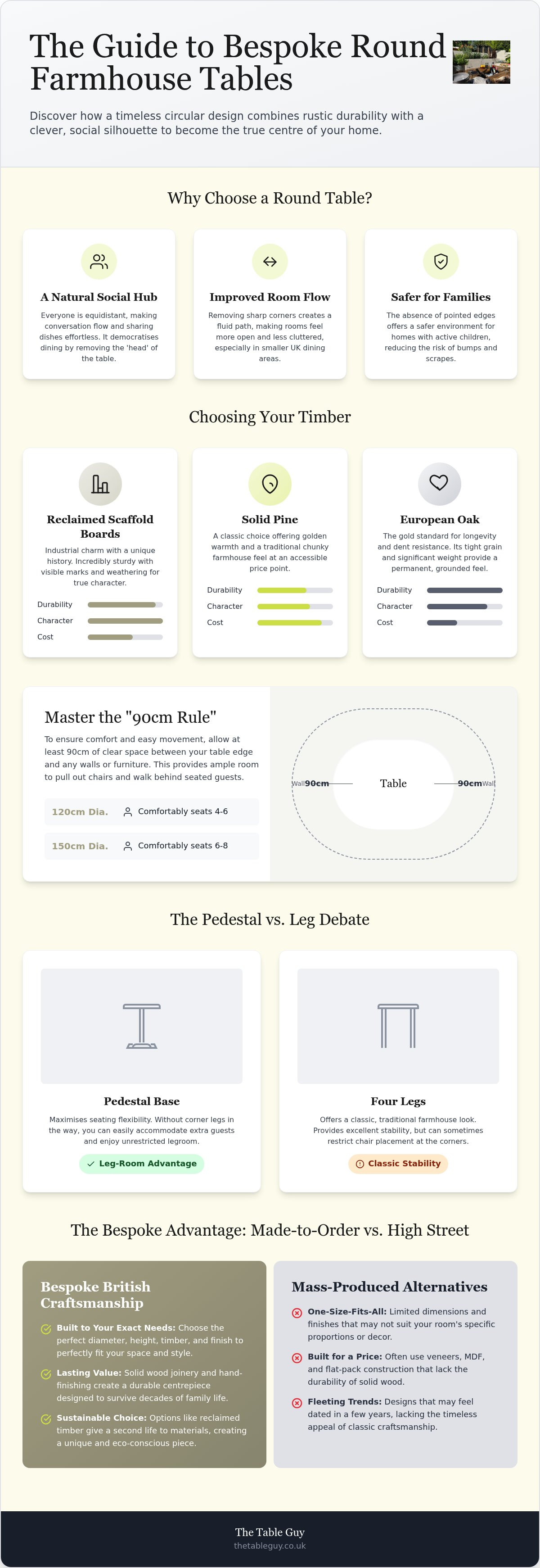
Finding the perfect dimensions for your round farmhouse dining table is a balancing act between social capacity and room for movement. In our experience, many people overestimate how much space they have, whilst others forget that chairs need to be pulled out comfortably. To ensure your dining area doesn't feel like an obstacle course, we always recommend the "90cm Rule". This means leaving at least 90cm of clear space between the edge of the table and the nearest wall or piece of furniture. This allows guests to sit down and others to pass behind them without a squeeze.
A quick guide to seating capacities for circular designs:
90cm Diameter: Perfect for a cosy nook, seating 2 to 3 people comfortably.
120cm Diameter: The standard for a family of four, often squeezing in a fifth guest.
150cm Diameter: A grander choice for 6 to 8 people, ideal for dedicated dining rooms.
If you host the whole family for Sunday roasts but want to keep your floor space during the week, consider our extendable dining tables. They offer the best of both worlds, providing a compact footprint for daily life and a generous surface for special occasions.
Measuring Your Room for a Circular Flow
Visualising a circle in a square room can be tricky. Don't guess. Grab some old newspapers or masking tape and lay out the diameter on your floor. It’s the best way to see how the footprint interacts with your space. Follow these steps for an accurate fit:
Identify the centre point of your dining area, usually directly beneath a pendant light or in the middle of a bay window.
Measure the distance from that centre point to the nearest wall or furniture obstruction.
Subtract 90cm from that measurement to find your ideal radius, then double it for the total table diameter.
Small Space Solutions: The 4ft Farmhouse Table
The 120cm, or 4ft, diameter is our most requested size. It’s the "sweet spot" for most UK homes, offering enough room for a full dinner service without dominating the kitchen. If space is really at a premium, you can pair your table with curved benches that tuck away even tighter than chairs. Remember, because every piece is made to order, a custom farmhouse dining table can be built to the exact centimetre to fit your specific alcove. If you're unsure which size will work for your home, get in touch with our workshop team for expert advice on your layout.
The Bespoke Advantage: Why Made-to-Order Trumps High-Street
High-street "fast furniture" is often a race to the bottom. It relies on thin veneers and particle board that swells at the first hint of a spill. In contrast, a bespoke round farmhouse dining table is an investment in longevity. We use solid timber and traditional joinery because we believe furniture should outlast its owners. When you choose made-to-order, you aren't just buying a product; you're supporting a lineage of UK craft. You get to decide the exact stain, the specific paint colour, and even the edge profile. This level of tailoring comes at no extra cost because every table starts as raw timber in our workshop. It is built for your life.
We also want to help you furnish your entire home without compromising on quality. Our unique "Buy One Table, Get One Half Price" offer makes it easier to pair your new dining centrepiece with a matching coffee table or sideboard. It's a sustainable way to create a cohesive look using authentic materials. You don't have to settle for "close enough" when you can have exactly what you need.
From Workshop to Home: Your Table’s Journey
Every table undergoes a meticulous hand-finishing process. We sand, wax, and inspect every joint with the kind of scrutiny only a small, family-run team can provide. There is a deep sense of pride in knowing your furniture wasn't just "picked" from a warehouse shelf. It was created specifically for your home. This transparency is what builds trust. You are invited into the story of the piece before it even reaches your front door. Our quality control isn't a checklist; it's a matter of personal reputation.
Designing Your Dream Round Table
Don't feel restricted by standard catalogue sizes. If you need a specific diameter to fit an awkward bay window or a unique alcove, just contact our workshop. We love a challenge. You can even include integrated features similar to those found in our famous Prosecco dining tables. By choosing bespoke, you join a community of over 2,500 happy owners who value character over convenience. Browse our full range today and let's start building something timeless together.
Bring the Heart of the Workshop into Your Home
Choosing a round farmhouse dining table is about more than just filling a room; it’s about creating a space where conversation flows as naturally as the grain of the wood. We’ve explored how the right timber, whether it’s the storied texture of reclaimed scaffold boards or the timeless strength of oak, provides a foundation that mass-produced alternatives simply can’t match. By mastering the 90cm rule and selecting a support that suits your lifestyle, you ensure your centrepiece is as practical as it is beautiful.
Since 2014, our family-run team has hand-crafted over 2,500 bespoke tables in our UK workshop, earning features in The Sunday Times and Real Homes. We take immense pride in every joint and finish. It’s a dedicated process that results in furniture built to endure the beautiful chaos of family life for decades. Browse our collection of bespoke round farmhouse dining tables and find the perfect fit for your home today. Your dream dining space is just a conversation away. We look forward to building it with you.
Frequently Asked Questions
How many people can comfortably sit at a 120cm round dining table?
A 120cm diameter table is the ideal size for four adults to dine comfortably. Because a round farmhouse dining table has no corners, you can often squeeze in a fifth guest for social gatherings without anyone feeling cramped. This 4ft size provides enough surface area for full place settings and central serving dishes whilst remaining compact enough for most UK kitchen-diners.
Is a round farmhouse table better for a small room than a square one?
Yes, circular designs are far superior for tight spaces. Square tables have sharp corners that can block walkways and make a room feel segmented. The curved edge of a round table encourages a natural "flow" around the furniture, making the area feel larger. It also takes up less visual volume, which prevents a smaller room from feeling cluttered or overwhelmed by the furniture.
Do round farmhouse tables come apart for delivery into tight UK hallways?
We design our tables with practical UK homes in mind. The tabletop and the pedestal base are typically delivered as separate components to ensure they fit through standard doorways and narrow hallways. Our team then assembles the piece in your room of choice. This modular approach ensures that even the largest 150cm designs can reach their destination without any stress or structural damage.
How do I maintain the natural wood finish on a round pedestal table?
Maintenance is straightforward and rewarding. We recommend applying a high-quality clear furniture wax every six months to keep the timber hydrated and protected from spills. For daily cleaning, simply use a damp cloth and avoid harsh chemical sprays that can strip the natural oils. This simple routine preserves the wood's unique patina and ensures your centrepiece continues to look beautiful as it ages.
Can I choose a custom Farrow & Ball colour for the pedestal base?
You certainly can. One of the greatest benefits of the bespoke process is the ability to choose your own palette. We can finish your table base in any Farrow & Ball shade to match your existing kitchen cabinetry or wall colours. This customisation is included as part of our made-to-order service, allowing you to create a piece that feels perfectly integrated into your home's decor.
Is reclaimed scaffold board wood safe for a dining table with children?
Our reclaimed timber is perfectly safe for family life. Every board is kiln-dried and sanded extensively in our workshop to remove splinters and rough edges. We then seal the wood with food-safe waxes or oils that are non-toxic. The naturally rounded shape of a circular table is actually safer for young children than rectangular alternatives, as there are no sharp corners at head height.
What is the best way to measure my room for a round table footprint?
The most reliable method is using masking tape or old newspapers. Mark the centre point of your dining area and layout the diameter on the floor. You must ensure there is at least 90cm of clear space between the table edge and any walls or other furniture. This gap is essential for pulling chairs out comfortably and allowing people to walk behind seated guests without a struggle.
Why are pedestal bases more popular for round tables than four legs?
Pedestals are favoured because they offer total seating flexibility. Without four corner legs in the way, guests don't have to straddle any supports, and you can tuck chairs fully under the table when they aren't in use. This creates a much cleaner silhouette and makes it far easier to accommodate an extra person at short notice. It is the ultimate design for social, inclusive dining.


Comments