
The Ultimate Guide to the Extending Farmhouse Dining Table: British Artisan Quality
Imagine the frustration of a festive dinner where the table begins to sag under the weight of the roast, or the extension leaves look like an afterthought rather than a part of the design. You've likely felt the annoyance of a "matching" leaf that doesn't actually match the grain, or a mechanism so stiff it requires two people and a lot of patience to operate. We believe your furniture should work for you, not against you. A bespoke extending farmhouse dining table is more than just a surface for meals; it's a tactical hosting tool designed to adapt to the unique rhythm of your British home.
You deserve a space that feels intimate for a Tuesday morning coffee yet expands effortlessly for a Sunday gathering of twelve. We're going to show you how artisan joinery solves the common pitfalls of mass-market tables, ensuring your furniture remains sturdy for decades. This guide explores the engineering of smooth mechanisms, the art of grain matching, and expert advice on seating large groups comfortably. From our workshop to your home, let's discover how to choose a piece that survives the beautiful chaos of family life whilst maintaining its timeless, hand-crafted elegance.
Table of Contents
The Extending Farmhouse Dining Table: Versatility Meets British Tradition
The farmhouse table is the heartbeat of a British home. It carries the weight of daily life, from school projects and morning coffee to the clatter of a Sunday roast. When you choose an extending farmhouse dining table, you aren't just buying furniture; you're investing in a tactical tool for hosting. This style draws its soul from the history of the refectory table, where long, solid timber surfaces were essential for communal monastic life. Today, that same rugged charm is distilled into a design that feels both historic and remarkably modern. It's about that emotional shift. One moment, it's a quiet, cosy spot for your family breakfast. The next, it's a grand stage for a celebratory feast. Bespoke craftsmanship ensures this transition is seamless, keeping the table a proud centrepiece rather than a clunky compromise.
The Anatomy of a Farmhouse Classic
Visual weight is everything. A true farmhouse aesthetic relies on substantial, thick table-tops that suggest they'll last for generations. It's about texture you can feel. Whether you prefer the elegant curves of traditional turned legs or the crisp, clean lines of a contemporary straight-leg design, the foundation must be solid. Natural wood grain plays the starring role. In our workshop, we see how the unique knots and swirls of the timber create a welcoming atmosphere that mass-produced plastic or veneer simply cannot replicate. It's honest furniture. It doesn't hide its origins. We focus on structural joinery that avoids the flimsy feel of flat-pack alternatives, ensuring every piece feels as sturdy as it looks.
Why 2026 Homeowners are Choosing Extending Designs
UK homes, particularly terraces and semi-detached properties, often demand clever spatial thinking. You don't want a massive table dominating your room every day, yet you need the capacity to be "party-ready" at a moment's notice. This drive toward multi-functional living has made the extendable feature a modern necessity. It allows you to maximise your floor space without sacrificing your ability to host the whole family. A 6ft table that extends to 8ft or 10ft is the "Goldilocks" size for British families because it fits perfectly into standard dining rooms whilst offering the generous elbow room needed for a full Christmas spread. Choosing a made-to-order piece means your table is built to the millimetre, ensuring a perfect fit for your specific layout and lifestyle.
Bespoke Extension Mechanisms: How Artisan Joinery Beats Mass-Market Retail
Mass-market tables often rely on flimsy butterfly hinges or thin veneers that inevitably chip at the edges. In our workshop, we take a different path. We often employ the "Breadboard End" method, a traditional joinery technique that allows the solid timber to expand and contract naturally whilst keeping the surface perfectly flat. When you expand your extending farmhouse dining table, the transition should be invisible to the eye. We achieve this by grain-matching every piece, ensuring the pattern flows beautifully from the main table into the extension leaf. This level of care is essential when choosing the right timber, as it prevents the mismatched, "bolted-on" look common in high-street furniture.
The Strength of Solid Wood Joinery
Stability is the foundation of any great dining experience. Many homeowners have experienced the "extension dip" where the ends of the table sag under a heavy platter. We prevent this by building reinforced under-frames that support the full weight of the extended surface. We use traditional dowels and mortise-and-tenon joints rather than simple screws. Screws can loosen or strip the wood over time; a hand-crafted joint remains steadfast. This structural integrity means our tables handle the "weight of the feast" far better than any flat-pack alternative. It's the difference between a table that lasts a few seasons and one that becomes a family heirloom.
Operating Your Extending Table
We believe hosting should be a joy, not a chore. That's why our mechanisms are designed for effortless, one-person operation. You won't need to recruit a helper just to pull the table apart. Homeowners often ask about storage; internal leaf storage keeps everything together, whilst separate storage allows for a slimmer, more elegant table rail. Both have their merits. Clip-on extensions are a favourite for those prioritising rock-solid stability, as they lock into the frame with no room for movement. For a deeper look at these options, read The Ultimate Guide to Choosing an Extendable Dining Table: Bespoke British Craftsmanship. These systems ensure a rattle-free experience, even when the house is full. If you want to see these designs in action, you can view our bespoke table collections to find your perfect match.
Material Matters: Choosing the Right Timber for Your Extending Table
The choice of timber is perhaps the most personal part of the commissioning journey. It dictates how your table feels under your hand and how it carries the weight of those extra leaves. Whilst mass-market retailers often hide cheap MDF under a thin layer of veneer, we believe in the honesty of solid wood. Choosing the right material for your extending farmhouse dining table ensures that the extensions feel like a natural part of the structure, not a flimsy addition. From the rugged, storied boards of a building site to the refined elegance of slow-grown oak, every timber we use in our workshop is selected for its ability to survive decades of family life.
Sustainability is the golden thread that runs through our workshop. We don't just build for today; we build pieces that won't end up in a landfill. By sourcing timbers that are either reclaimed or sustainably grown, we ensure your furniture has a minimal environmental footprint. Whether you choose the industrial character of scaffold board or the premium finish of sustainable hardwoods like oak or bamboo, you're investing in a material that actually improves with age. These woods handle the mechanical stress of extension leaves far better than composite materials, maintaining their alignment and strength even after years of use.
The Unique Character of Scaffold Board
If you're looking for a table with a story, scaffold board is the industrial choice for a high-character farmhouse look. We embrace the history of the wood, leaving the knots and nail holes that tell of its previous life. Our meticulous sanding process ensures that whilst the character remains, the surface is completely splinter-free and tactile. It's arguably the most durable choice for active families with children. The wood is naturally resilient, and because it already features a weathered aesthetic, a new scratch or "oops" from a toddler simply adds to the table's evolving narrative.
Selecting Your Finish and Colour
The finish you choose is your table's first line of defence. When deciding between wax and oil, consider your hosting style. Wax provides a beautiful, traditional sheen and is excellent for highlighting grain, whilst high-quality oils often provide a deeper level of protection against wine spills and heat. For more detail on these choices, explore our Material Spotlight: Choosing Wood for Your Hosting Table. A dark wax finish can transform new pine into a deep, antique-style centrepiece that feels like it has been in the family for generations. This customisation allows you to match your table perfectly to your existing kitchen decor, ensuring a seamless fit for your home.
Seating Ergonomics: Planning for 6, 10, or 12 Guests
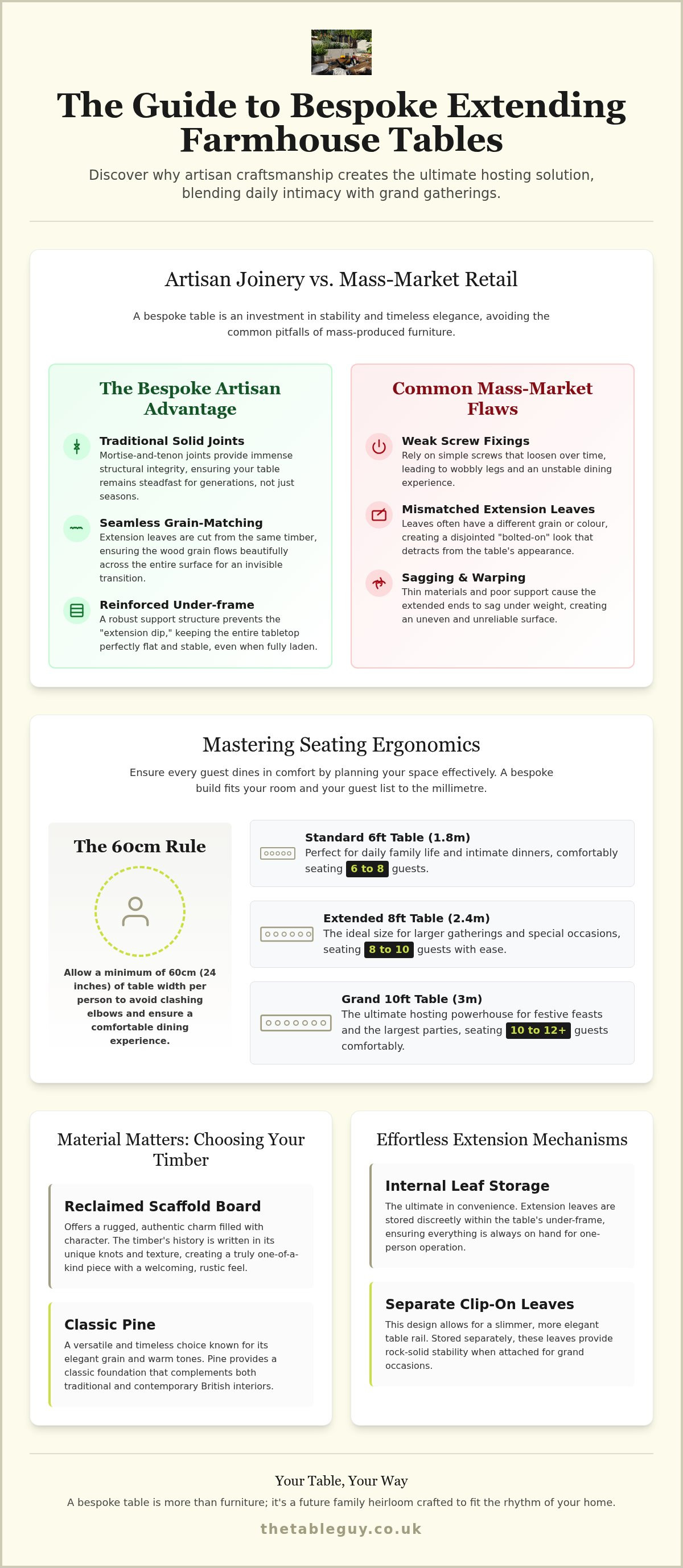
Hosting a grand dinner shouldn't feel like a game of Tetris. If you've ever been the guest trapped at the corner of a table with a chunky leg between your knees, you know that dimensions matter just as much as the timber itself. For a bespoke extending farmhouse dining table, we always recommend the "60cm Rule". This is the minimum width each person needs to dine comfortably without clashing elbows. When you add your extensions, this rule remains your baseline for success. It's the difference between a relaxed evening and a cramped squeeze where nobody can move their cutlery.
Clearance is the other half of the hosting puzzle. You need to leave at least 90cm of space behind your chairs to allow guests to move around the room whilst others are seated. If your dining room is on the narrower side, bench seating is our favourite space-saving secret. Benches allow you to tuck seating completely under the table when it's not in use, and they're perfect for squeezing in a few extra children during the holidays. They offer a communal, rustic feel that perfectly complements the farmhouse aesthetic.
Layout Planning for Big Occasions
Transitioning from a 6-seater daily layout to a 12-seater hosting setup requires a bit of foresight. You need to consider the width of your chairs; bulky armchairs might look beautiful, but they'll limit how many people you can fit along the length. As we explore in The Ultimate Guide to Designing a Custom Farmhouse Dining Table in 2026, matching your chair width to your table length is essential for a balanced look. We often suggest choosing slimmer side chairs for the long edges and saving the wider "carver" chairs for the ends. This layout maximises every centimetre of your extended surface.
Visualising the Table in Your Room
Before you commit to a size, we always advise using masking tape on your floor to mark out the "fully extended" footprint. Don't just measure the table; account for sideboards, doorways, and radiators. If you have the space, opting for a 100cm width instead of the standard 90cm provides much-needed room for central serving platters and decorations. This extra depth ensures your table doesn't feel cluttered when the extensions are in place. It's about creating a flow that works for your specific home. If you're ready to start planning your layout, view our farmhouse table collections to see which dimensions suit your space best.
Commissioning Your Bespoke Extending Table with The Table Guy
The heart of our business is our workshop. It's a space where traditional skills meet modern needs, far removed from the cold, automated assembly lines of mass-market retail. Since 2014, we've focused on a "made-to-order" philosophy, rejecting the one-size-fits-all approach that often leaves homeowners compromising on fit or finish. When you commission an extending farmhouse dining table from us, you're buying a piece of British heritage. You're supporting a family-run enterprise that values quality over quantity. Every knot in the timber and every joint in the frame is handled by a person who cares about the final result. We don't hide behind corporate desks. We're on the workshop floor, ensuring your table is perfect.
Precision is our promise. We don't do "standard" sizes because we know that UK homes come in all shapes and sizes, from narrow Victorian terraces to expansive modern conversions. Our millimetre-perfect sizing allows you to reclaim your floor space whilst ensuring you're always ready for a crowd. You'll deal with the same artisans who select your timber and hand-finish your table-top. This human touch creates a level of accountability and passion you simply won't find in a high-street showroom. It's a partnership between your vision and our hands.
Tailoring the Specifications to Your Home
Customisation goes beyond just the length and width. Choosing the right leg style is crucial for grounding your room's aesthetic. You might prefer chunky, rustic blocks for a rugged look, or perhaps elegant, hand-turned designs that add a touch of traditional sophistication. We also customise the extension lengths to suit your specific hosting needs. If you need a specific extra 50cm to clear a radiator or doorway, we build it to those exact requirements. This bespoke approach can be carried throughout your home. If you're looking to complement your new dining area, our Bespoke Shelving Units UK: The Ultimate Buying Guide to Custom Artisan Storage offers insights into matching your storage to your furniture.
The Journey from Workshop to Dining Room
The process begins with a conversation. We talk through your layout, your timber preferences, and how you plan to use the space. Once the design is settled, our artisans begin the build, using the solid structural joinery that defines our work. We don't use flimsy flat-pack methods. We build furniture that survives decades of family use. When the piece is ready, our national UK delivery network takes over. We handle every table with extreme care, ensuring it arrives at your door in perfect condition, ready for its first family meal. Starting your bespoke journey is simple. Get in touch for a quote and let's discuss your vision today.
Your Journey to a Truly Bespoke Dining Experience
Choosing an extending farmhouse dining table means you're no longer limited by the dimensions of your room or the length of your guest list. We've explored how traditional joinery and careful material selection create a piece that is as robust as it is beautiful. From the tactile history of scaffold board to the precision of a hand-turned leg; every detail matters. You now have the tools to plan your seating layout with confidence, ensuring every guest enjoys the generous elbow room they deserve.
Since 2014, our family-run workshop has been dedicated to preserving these artisan skills for modern British homes. We don't believe in the compromises of mass-market furniture. Instead, we offer national UK delivery on made-to-order pieces that are built to survive the beautiful chaos of family life. It's time to move away from wobbly, flat-pack alternatives and invest in a centrepiece that grows with your family. Start designing your bespoke extending farmhouse table today and let our craftsmen bring your vision to life. Your perfect hosting space is just a conversation away.
Frequently Asked Questions
How many people can comfortably sit at an extending farmhouse table?
Comfortably seating your guests depends on the total length of your extending farmhouse dining table. We recommend allowing 60cm per person for a relaxed dining experience. A standard 6ft table seats six people daily; however, adding two extension leaves can increase your capacity to ten or even twelve guests. We build every piece to your specific needs, so we can calculate the exact length required to accommodate your largest family gatherings without anyone clashing elbows.
Do the extension leaves store inside the table?
We offer both internal and separate storage options for your extension leaves. Internal storage keeps the leaves tucked neatly within the table frame, which is perfect for convenience. Alternatively, separate storage allows for a slimmer, more elegant table rail design. During the design process in our workshop, we'll discuss which method best suits your home's layout and your aesthetic preferences, ensuring the mechanism is easy for one person to operate alone.
Will the wood grain on the extensions match the main table?
Achieving a seamless grain match is the hallmark of a master craftsman. Unlike mass-market retailers who use mismatched timber or veneers, we hand-select every board to ensure the pattern flows naturally from the main table into the extensions. This attention to detail creates a cohesive, high-quality look whether the table is closed or fully extended. It's one of the primary reasons homeowners choose a made-to-order piece over a generic high-street alternative.
Is an extending table as sturdy as a fixed-top farmhouse table?
Yes, our extending designs are built with the same structural integrity as our fixed-top models. We use reinforced under-frames and traditional joinery techniques, such as mortise-and-tenon joints, to prevent the sagging or wobbling often found in flat-pack furniture. Every extending farmhouse dining table is engineered to handle the weight of the feast without compromise. You can host large Sunday roasts with total confidence in your table's stability and long-term strength.
How do I maintain the wax finish on my handmade table?
Maintaining your table's hand-applied wax finish is straightforward. We recommend applying a fresh coat of high-quality furniture wax every six to twelve months to keep the timber hydrated and protected. For daily care, simply wipe the surface with a damp cloth and avoid harsh chemical cleaners. Using coasters for hot drinks and wiping up spills immediately will ensure the wood's natural character and protective barrier remain intact for decades of family use.
Can I choose a custom width for my extending dining table?
Absolutely, as everything we create is made-to-order in our UK workshop. Whilst 90cm is a standard width, many customers opt for 100cm or more to allow extra room for central serving platters and festive decorations. Because we don't use "standard" templates, we can adjust the width to the millimetre to fit your specific dining room layout perfectly. This ensures your table feels balanced within your home's unique proportions and architectural features.
How long does it take to build and deliver a bespoke extending table?
Our lead times for bespoke builds are determined by current workshop demand and the specific requirements of your design. Every piece is hand-crafted from scratch, a process that requires time and meticulous attention to detail. Once your table passes our final quality checks, we'll coordinate a safe delivery via our national UK network. We'll keep you informed at every stage of the journey, from the first sketch to the final delivery.
What is the best wood for an extending farmhouse table?
The best wood depends on your lifestyle and aesthetic goals. Traditional pine is a versatile classic that takes stains beautifully, whilst scaffold board offers a rugged, industrial character that's incredibly durable for active families. If you're looking for a more polished, premium finish, sustainable hardwoods like oak or bamboo are excellent choices. Each timber we source is selected for its strength and ability to handle the mechanical requirements of an extending mechanism without warping.


Comments