
Sustainable Wood Furniture UK: 2026 Buyer’s Guide
Updated: Oct 20
Choosing sustainable wood furniture in the UK means looking beyond a timber label or a natural-looking finish. Consider where the material came from, how the furniture is made and whether its design suits the way you’ll use it. Clear sourcing information and a well-matched design are more useful than a broad promise such as “eco” or “natural”.
This guide explains how to compare timber origins, certification claims, materials and construction. It also covers practical checks, from measuring your space to considering maintenance and future reuse. The Table Guy is a family-run UK business, established in 2014, that makes bespoke furniture to order in its workshop. Its material choices include bamboo, hardwood, pine and scaffold board. Use the guidance below to identify what matters for your home, then explore how made-to-order craftsmanship can help shape a practical, personal piece.
Table of Contents
What makes wood furniture sustainable? Start with the whole piece
How to assess wood sourcing, certifications and construction
Bamboo, hardwood, pine or scaffold board: compare materials by purpose
A practical checklist for buying sustainable wood furniture in the UK
Choose bespoke wood furniture made around your home and everyday life
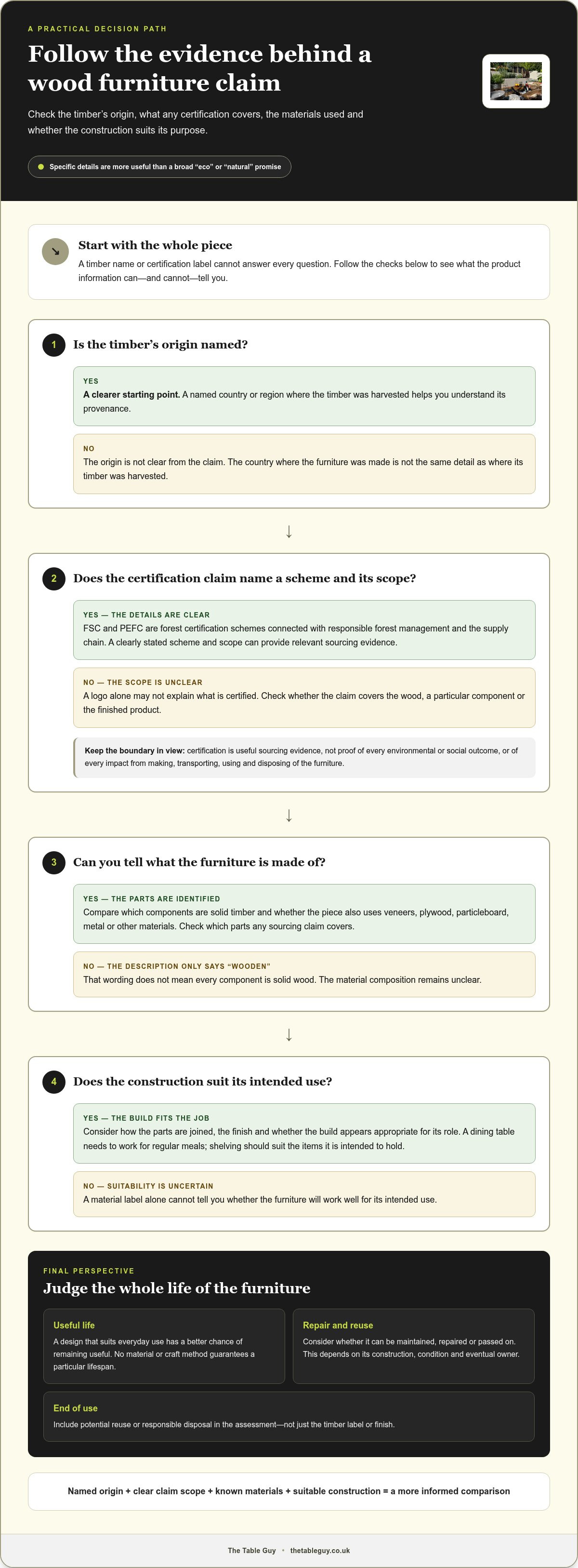
What makes wood furniture sustainable? Start with the whole piece
A timber species alone can’t tell you whether a table or sideboard is a responsible choice. Consider where the wood came from, how the furniture is designed and constructed, whether it suits its intended use, and what might happen to it when it is no longer needed. A natural finish may look appealing, but it is not proof of responsible sourcing or durable construction.
Think about the whole life of the furniture: its sourcing, design, useful life and potential for repair, reuse or responsible disposal. This gives you a more balanced way to compare sustainable wood furniture UK options than relying on a material label or environmental slogan.
What should a sustainability claim tell you?
A useful claim should be specific enough to assess. Look for the timber’s origin, the sourcing standard or certification involved, and which material or component the claim covers. If a piece combines solid wood with other materials, don’t assume a claim about one component applies to the entire item.
FSC and PEFC are forest certification schemes, with standards and systems relating to responsible forest management and the supply chain. Their labels can provide relevant sourcing evidence, but they do not prove every environmental impact associated with making, transporting, using or disposing of a particular piece. The overview of certified wood and forest management standards explains the general context. For a specific product, focus on the wording of the certification claim and what it covers.
More informative: a named timber origin, a clearly identified scheme and an explanation of which parts are covered.
Less informative on its own: broad wording such as “natural” or “eco-friendly”, without details you can understand or verify.
Worth treating cautiously: claims such as “greenest” or “100% sustainable” when no clear evidence or boundaries are provided.
Use these distinctions to compare claims, not to conclude that missing detail proves a product is harmful. A clear, specific statement is simply more useful than a sweeping promise.
Why lifespan belongs in the sustainability conversation
Furniture that suits its everyday role has a better chance of remaining useful. Consider whether its size, shape and construction make sense for the way you’ll use it. A dining table needs to work for regular meals, while shelving should suit the items it is intended to hold. Robust construction and thoughtful design can support long-term use, but no material or craft method guarantees a particular lifespan.
Repairability and future reuse are worth considering too. A design that can be maintained, repaired or passed on may stay in use longer, although that depends on its construction, condition and eventual owner. Ask yourself whether the furniture is practical for your home now and whether its design is likely to remain useful if your needs change.
Judge the whole item: sourcing evidence helps explain where its materials come from, while construction and suitability help you assess how well it may serve you. Neither a timber name nor an environmental slogan answers every question on its own.
How to assess wood sourcing, certifications and construction
Turn broad sustainability language into details you can compare. For sustainable wood furniture UK buyers, a useful claim identifies the material and the evidence behind it. Use this checklist to examine a piece’s sourcing and construction before deciding whether it suits your priorities.
Trace the origin. Look for the country or region where the timber was harvested, rather than relying on the country where the furniture was made. A named origin gives you a clearer starting point for understanding provenance.
Read the certification claim closely. Identify the scheme and check whether the claim applies to the wood, a particular component or the finished product. A logo alone may not make the scope clear.
Check the material composition. Find out which parts are solid timber and whether the piece also uses veneers, plywood, particleboard, metal or other materials. “Wooden” does not necessarily mean every component is solid wood.
Consider the construction. Look at how the parts are joined, the finish used and whether the build appears appropriate for the furniture’s intended use. A dining table and a decorative shelf have different practical demands.
What FSC and PEFC labels can, and can’t, tell you
FSC and PEFC are certification schemes connected with forest management and the supply chain for forest-based materials. Their standards and systems can provide evidence about sourcing, but each certification claim has a defined scope. It should not be taken as proof of every environmental or social outcome linked to a piece of furniture. Look for wording that states what is certified and whether it covers the relevant wood or finished product.
Claims can apply to different parts of an item. A certified timber top, for example, does not automatically mean the frame, backing or other components are covered by the same claim. If the product information distinguishes those parts, you can make a more informed comparison. Treat certification as useful evidence, not a complete account of a product’s impact.
How construction affects a furniture buying decision
Solid timber describes material made from wood, while engineered components are formed from wood fibres, particles or layers, sometimes with a veneer on the surface. Neither label proves that a piece is more sustainable. Consider what each component does, how clearly its materials are described and whether the construction suits the item’s use.
Visible details such as even joins, stable connections, smooth edges and a consistent-looking finish can help you assess workmanship, but they cannot establish a precise lifespan. A table used for daily meals needs a build that feels suited to regular use; shelving should be designed for its intended role. Focus on fit and function rather than a promise of permanence.
Made-to-order furniture can be shaped around a room and its intended use. If you’re considering a bespoke table or storage piece, explore furniture made to order as a way to bring practical requirements into the design from the outset.
Bamboo, hardwood, pine or scaffold board: compare materials by purpose
Start with the job the furniture needs to do, then consider the material’s look, care requirements and sourcing evidence. A dining table used every day has different demands from a coffee table or shelving. Bamboo, hardwood, pine and scaffold board each offer distinct possibilities, but the material name alone does not tell you how a finished item will perform or where its material came from.
No wood type is sustainable by name alone. For sustainable wood furniture UK buyers, the fairest comparison considers similar pieces and looks at their materials, construction, intended use and sourcing evidence together.
Which material suits the way you will use the furniture?
Begin with the setting and your routine. For a dining table, consider regular meals, available space and the visual character you want at the centre of the room. For a coffee table, think about its position in the seating area and how you’ll use its surface. For shelving, focus on the items it needs to hold and how it will sit alongside the rest of the room. Choose a material that suits the piece, not just one that catches your eye.
Hardwood needs particular attention because it describes a wide range of species, not one uniform material with identical qualities. Check which species is named and compare like with like. Consider maintenance too: does the finish and its care guidance fit your household and the time you’re willing to give the piece? Avoid assuming a familiar material will need the same upkeep in every design.
How to compare material claims fairly
Keep comparisons even. Look at furniture designed for a similar use, with comparable construction details and sourcing evidence. A claim that bamboo grows quickly, or that a timber has a distinctive natural appearance, does not establish responsible sourcing or whole-life performance on its own. Check what evidence relates to the actual product and how its design supports the way you expect to use it.
If you’re weighing bamboo for outdoor style, the bamboo garden furniture guide offers a more focused discussion. Use it alongside product-specific sourcing and care information, rather than treating the material name as a shortcut to a sustainability verdict.
A practical checklist for buying sustainable wood furniture in the UK
Make the practical decisions first, then compare materials and sourcing evidence. Furniture that fits your room, serves its purpose and suits your daily routine is more likely to remain useful than an impulse choice that looks appealing but proves awkward at home. Use this checklist to clarify your priorities before settling on a design.
Questions to settle before choosing a piece
Measure the room and the route in. Record the intended location, including nearby doors, walkways and other furniture. Measure access routes such as hallways, stairways and door openings too. Floor space alone does not tell you whether a table or sideboard can reach its place.
Define its everyday job. What needs to fit on the surface, sit around it or be stored on it? For a dining table, consider how many people it needs to accommodate in your usual routine. For shelving, think about the items it needs to support and display.
Set your design priorities. Decide which details matter most, such as the material’s character, the shape or how the piece will sit with your existing furniture. Note where you can be flexible, so a preference does not outweigh practical fit.
Compare materials and evidence. Once you know the intended use and design direction, weigh material options alongside sourcing information, construction and likely maintenance. Do not choose by timber name or appearance alone.
Made-to-order dimensions can help a piece work in a particular room, especially where a standard size would leave awkward gaps or restrict movement. They also let you start with the intended use rather than trying to make a ready-made shape fit your home. The custom farmhouse dining table guide explores decisions that can shape a table around your space and household needs.
How to weigh environmental priorities against practical needs
Rank what matters to you: sourcing evidence, everyday suitability, maintenance and design fit. Use that order to compare options consistently. A particular look may be important, but it should not obscure whether the piece will work in the space or whether its material information is clear.
An item that suits your needs may stay useful longer than one bought quickly and later found unsuitable. That does not mean made-to-order furniture is automatically greener. Its value depends on the materials, evidence, construction and how well it serves its intended role. If your dining arrangements need flexibility, an extendable dining table guide can help you weigh that requirement alongside size and design.
For furniture shaped around your space and everyday use, explore bespoke furniture made to order.
Choose bespoke wood furniture made around your home and everyday life
A considered furniture choice brings together practical use, personal taste and clear thinking about materials. The Table Guy is a family-run business established in 2014, making bespoke furniture to order in its workshop. Its material categories include bamboo, hardwood, pine and scaffold board, and its furniture includes dining tables, coffee tables and shelving.
Made-to-order craftsmanship gives you a different starting point from choosing a piece by appearance alone. Begin with the room and your routine: how much space is available, what the furniture needs to do, and which design details will help it feel at home. These decisions can guide the dimensions and overall design, connecting the piece’s form with the way you plan to use it.
What made-to-order craftsmanship can personalise
Think through the details that matter in everyday life. A dining table may need to fit a particular part of the room and suit how your household gathers around it. A coffee table has a different role, while shelving needs to work with the space and the belongings you want to arrange. Defining these uses gives the design a clear purpose before you settle on a material.
Then consider the character you want the furniture to bring to the room. Bamboo, hardwood, pine and scaffold board each have their own visual qualities, but none is automatically the most sustainable choice. Compare the specific sourcing evidence available for the material, the construction of the piece and how well its design suits its intended use. Bespoke design does not prove a lower environmental impact by itself; its value lies in shaping furniture around considered requirements.
A personal fit can be practical as well as aesthetic. Dimensions planned for the intended location may help avoid a piece that obstructs a walkway or leaves useful space awkwardly unused. Furniture designed with its everyday role in mind may also be easier to live with over time. Keep your requirements clear: note essential measurements, how the furniture will be used, the look you prefer and any maintenance considerations.
Take the next step towards a considered piece
Before choosing, bring your priorities together: a suitable material, a useful design, dimensions that work in your home and clear evidence for any sourcing claim. This gives you a thoughtful basis for comparing options without expecting one timber name or a made-to-order label to answer every sustainability question.
If you’re ready to explore furniture shaped around your room and everyday life, take a look at bespoke wooden furniture from The Table Guy. Start with the piece you need and the way you want it to work. Material and design choices can then help turn a practical requirement into furniture that feels personal and worth keeping.
Make your next furniture choice a lasting one
Let your room guide the final choice. Rather than chasing an idealised label, consider how the piece will feel in your home and whether it can remain useful as your routines evolve. Furniture you’re glad to live with is more likely to earn a lasting place in your everyday surroundings.
Ready for a piece shaped around your space and preferences? Explore bespoke wooden furniture from The Table Guy and start with the furniture you need and how you want it to work in your everyday life.
Frequently Asked Questions
Is solid wood furniture always sustainable?
No. “Solid wood” describes how a component is made, not where the timber came from or its environmental performance. A solid-wood table and a veneered table need to be judged on their own evidence, design and likely use. Consider timber origin, sourcing information, construction and whether the piece suits your household. Also think about whether it could be maintained, passed on or otherwise reused when it is no longer needed.
Can bamboo furniture be considered sustainable?
It can be, but bamboo’s reputation for renewable growth does not establish the impact of a finished piece. Compare product-specific sourcing evidence, how the material has been processed and what is known about transport. A small occasional table and a frequently used dining table may have different construction needs and patterns of use. Consider whether the finished furniture is suited to those demands. Compare evidence for specific pieces rather than assuming bamboo is always the greenest option.
What does FSC-certified wood mean for a furniture buyer?
FSC is a forest-certification scheme, and its label can provide information about a sourcing claim. Check the exact wording and scope: it may relate to specified wood or a particular product claim, rather than every component. Do not treat the label as a guarantee of every environmental or social outcome. For precise definitions and current requirements, consult information published by FSC, then compare the claim with the materials identified for the furniture you’re considering.
Does PEFC certification mean a whole furniture item is sustainable?
No. PEFC relates to forest certification and responsible sourcing, but a PEFC statement has a defined scope. Check whether it refers to a particular wood component or a claim within the supply chain. Do not assume it covers every part of a finished cabinet or table. The label is not a complete lifecycle assessment either. Consider the item’s construction, other materials and likely use alongside the specific certification information.
Can wooden furniture be recycled or reused at the end of its life?
Possibly, but the options depend on the furniture’s condition, how it is built, its other materials and what local facilities accept. A sound table may be suitable for reuse or passing on, while a damaged piece with mixed materials or coatings may be harder to process. Before disposal, consider whether maintenance or repair could keep it useful. Check local council guidance for collection and recycling options, as arrangements vary across the UK.
Are water-based furniture finishes more sustainable than other finishes?
Not automatically. “Water-based” describes a type of finish, but it does not establish a product’s full environmental impact. Compare specific, substantiated information about the finish rather than relying on a broad marketing phrase. Also consider how the finish performs in the furniture’s intended setting and what care it needs. Avoid assuming water-based means impact-free.
How can I tell whether a furniture sustainability claim is credible?
Look for specific, traceable details about the materials, their sourcing and the scope of any certification. Check that the information relates to the actual piece, not just one material category or component, and note whether the claim is current. For sustainable wood furniture UK buyers, a clear, limited statement is more useful than an unqualified promise. Compare similar items using equivalent evidence, including what is known about construction and intended use.

Comments